The Power of Divine Remembrance (Dhikr): The Path to Allah’s Nearness and Spiritual Elevation
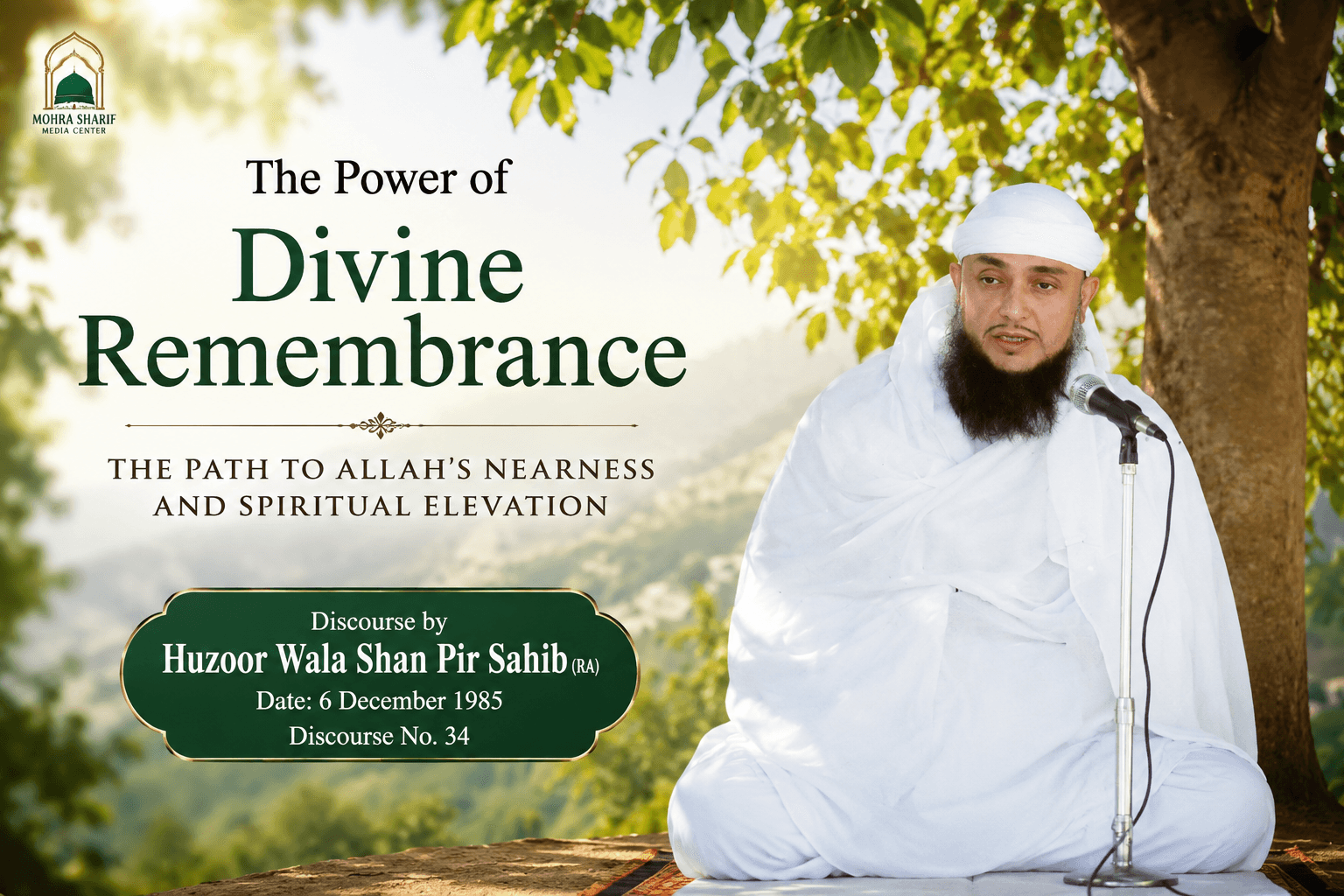
Address of Huzoor Wala Shan Pir Sahib (RA)
Date: 6 December 1985
Discourse No. 34
﷽
فَنِعۡمَ الۡمَوۡلٰی وَ نِعۡمَ النَّصِیۡرُ
رَبِِّ اشۡرَحۡ لِیۡ صَدۡرِیۡ وَیَسِّرۡ لِیۡۤ اَمۡرِیۡ وَ احۡلُلۡ عُقۡدَۃً مِّنۡ لِّسَانِیۡ یَفۡقَہُوۡاقَوۡلِیۡ
اَللّٰهُمَّ صَلِ عَلٰی سَیّدِنَا مُحَمَّدٍوَّعَلٰی اٰلِ سَیِّدِنَا مُحَمَّدٍوَّعَلٰی اَصْحَابِہٖ وَعَلٰی اَذْوَاجِہٖ اَجْمَعِیْنَ وَبَارِکْ وَسَلِمْ وَصَلِ عَلَیْہٖ
All praise is for Allah.
Countless thanks to Allah Almighty, the Sovereign of all sovereignty, Who has once again granted us the opportunity and honor to gather here for His pleasure, in His remembrance, and in His love. Millions upon millions of blessings and peace be upon the Leader of all Prophets, the Beloved of Allah, Prophet Muhammad (PBUH), through whose blessed mediation these divine favors have reached us.
Dear listeners,
Before we begin the recitation of the Awrad-e-Pak, it is necessary to understand one or two important points.
In the Holy Qur’an, while narrating the story of Prophet Musa (Moses, peace be upon him), Allah Almighty commanded:
اِذْهَبْ اَنْتَ وَاَخُوْكَ بِاٰيٰتِيْ وَلَا تَنِيَا فِيْ ذِكْرِيْ
“Go, you and your brother, with My signs, and do not become negligent in My remembrance.”
(Surah Ta-Ha 20:42)
How remarkable and profound this command is!
Allah is addressing one of the greatest Messengers, an Ulul-‘Azm Prophet, along with his brother, who is also a Prophet. They are being sent to Pharaoh to deliver Allah’s message—an act that is itself among the greatest forms of worship. Yet, despite the nobility of their mission, Allah still commands them to continue remembering Him constantly.
Why?
So that their mission may become even more blessed, their words may carry greater influence, the arrogant ruler may be defeated, and they may remain protected from Pharaoh’s trials and oppression.
One might think that going solely for the sake of Allah should have been sufficient. Obeying Allah’s command should have been enough. Being Prophets themselves was already an immense honor, and two Prophets together made the mission even more extraordinary. Then why was there still such emphasis on the remembrance of Allah?
This teaches us that Dhikr (the remembrance of Allah) is one of the greatest gifts Allah has bestowed upon humanity. It is also a form of supplication. Without it, neither the sinner nor the righteous, neither the poor nor the wealthy—and not even the Prophets—can truly do without it.
It is astonishing that some people consider the remembrance of Allah to be an innovation or something unnecessary. One wonders what kind of understanding they possess.
From this, we learn that the remembrance of Allah is the means of our forgiveness, the path to closeness with Allah, the source of deliverance from hardships, and the means of attaining our rightful goals. Neglecting it leads only to misfortune.
If someone is deprived of this blessing by destiny, there is little we can do. Our responsibility is simply to invite people toward the pleasure of Allah and to guide His servants to the path that Allah has taught us through the Holy Qur’an and the Sunnah of His Messenger (PBUH). Those destined to benefit will benefit, while those who are not will remain deprived.
Indeed, prayer and righteous deeds are sufficient for success, but the elevation of spiritual ranks comes through the remembrance of Allah.
A Hadith tells us that there will be different ranks in Paradise. Those in the lower levels will look upon those in the higher levels just as the people of the earth look toward the stars in the sky.
Had prayer alone been the distinguishing factor, everyone would have occupied the same rank. Rather, it is the remembrance of Allah that grants protection from great calamities and raises a believer to lofty spiritual stations.
Therefore, dear attendees of this gathering, remember this well: whether you are here or anywhere else, make the remembrance of Allah your daily practice, your constant occupation, and an inseparable part of your life. Never allow yourselves to become heedless of it, day or night.
Come now, let us recite these sacred words and humbly pray before Allah that He forgives all our past sins, makes us His true servants, frees our hearts from worldly attachments, immerses us in His love and the love of His Beloved Messenger (PBUH), and never allows us to become negligent of His remembrance.
May we live in His remembrance.
May we die in His remembrance.
And when we are raised on the Day of Resurrection, may His remembrance still be alive upon our hearts and our tongues.
Now, let us begin.
In the Name of Allah, the Most Compassionate, the Most Merciful.
The Awrad-e-Naziriyyah Sharif was recited, followed by a concluding supplication.