Love of the Prophet (PBUH): The Foundation of True Faith
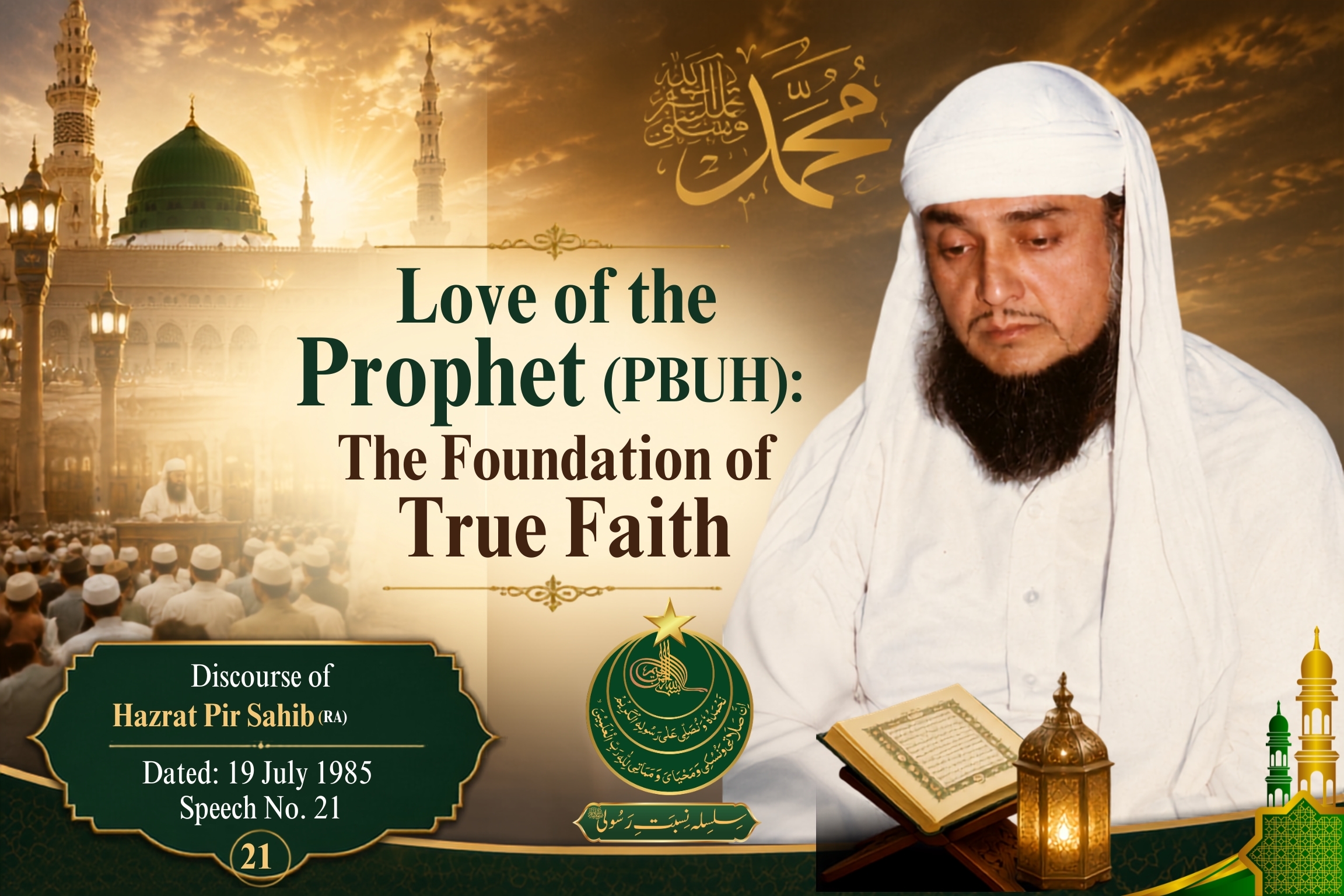
Discourse of Hazrat Pir Sahib (RA)
Dated: 19 July 1985
Speech No. 21
﷽
فَنِعۡمَ الۡمَوۡلٰی وَ نِعۡمَ النَّصِیۡرُ
رَبِِّ اشۡرَحۡ لِیۡ صَدۡرِیۡ وَیَسِّرۡ لِیۡۤ اَمۡرِیۡ وَ احۡلُلۡ عُقۡدَۃً مِّنۡ لِّسَانِیۡ یَفۡقَہُوۡاقَوۡلِیۡ
اَللّٰهُمَّ صَلِ عَلٰی سَیّدِنَا مُحَمَّدٍوَّعَلٰی اٰلِ سَیِّدِنَا مُحَمَّدٍوَّعَلٰی اَصْحَابِہٖ وَعَلٰی اَذْوَاجِہٖ اَجْمَعِیْنَ وَبَارِکْ وَسَلِمْ وَصَلِ عَلَیْہٖ
All praise is for Allah.
Countless thanks to Allah Almighty, the Sovereign of all sovereignty, Who has once again granted us the opportunity and ability to gather here for His pleasure, in His remembrance, and in His love. Millions and millions of blessings and peace be upon the Leader of all Prophets, the Beloved of Allah, Hazrat Muhammad Mustafa (PBUH), through whose blessed mediation we have received this favour.
Respected participants of this gathering! According to our usual practice, we shall begin the recitation of the sacred litanies (Awrad-e-Pak). However, before that, it is necessary to understand a few important points so that we may benefit fully from the blessings of these sacred recitations.
Before performing any act of worship, one must understand and firmly believe that worship is accepted in the Divine Court only when it is presented through the mediation of Allah’s Beloved (PBUH), and when the heart is filled completely with love and reverence for him. Even if a person spends day and night in worship, believing that he is pleasing Allah through his worship, yet there is no mediation of the Holy Prophet (PBUH) in his heart and devotion, then such worship resembles that of those who believe in Allah but are either unaware of, or deny, the authority of the Holy Prophet (PBUH). Indeed, very few deny the existence of Allah altogether, whether they are Hindus or followers of any other religion.
Furthermore, there is a vast difference between actions performed with sincerity and love and those performed without sincerity. Similarly, there is a difference between presenting the mediation of the Holy Prophet (PBUH) merely as a formality and presenting it with complete devotion and sacrifice of heart and soul. This very difference determines the acceptance of supplications.
A prayer that is accompanied by reverence and love for the Holy Prophet (PBUH) attains acceptance, and the doors of Divine response are opened. However, prayers made with pride, self-admiration, or self-conceit are either rejected or remain suspended.
It is important to understand that love and reverence for the Holy Prophet (PBUH) are not polytheism (shirk). Rather, they are a powerful means of breaking the doors of shirk and disbelief. Wherever Allah Almighty has commanded His love, obedience, and reverence, He has also commanded the honour, reverence, and love of the Holy Prophet (PBUH).
In fact, the very first stage of entering Islam is the declaration of faith (Kalimah Tayyibah). Without mentioning the Holy Prophet (PBUH), the declaration remains incomplete, monotheism is incomplete, and a person does not enter Islam.
La ilaha illallah Muhammadur Rasulullah
There is no god except Allah; Muhammad is the Messenger of Allah.
The Holy Qur’an commands the honour and reverence of the Holy Prophet (PBUH), and the Qur’an is filled with such verses. Satan, out of enmity, has attempted to mislead mankind by confusing reverence for the Messenger (PBUH) with shirk.
Shirk is a simple and well-understood matter. The foremost form of shirk is to consider someone other than Allah as God, Creator, or Eternal; or to worship someone other than Allah; or to believe that the authority of the Holy Prophet (PBUH) exists independently of Allah.
However, if one’s belief is that worship belongs solely to Allah, the Creator and Master, Who is One without partner, and that one loves the Holy Prophet (PBUH) because Allah is pleased with such love—since Allah Himself has commanded devotion and obedience to His Messenger, and because the Holy Prophet (PBUH) is the one who guides mankind to Allah and leads them to Him—then this is true Islam.
This is the principle of love: even the thorns found in the lane of the Beloved are dearer than flowers. How unfortunate it would be if one were to consider flowers as thorns and thus deprive oneself of their fragrance.
Love for Allah’s Beloved Messenger (PBUH) is the foremost condition of faith. Likewise, love for the devoted servants of the Messenger (PBUH) serves as a staircase leading to the Court of Allah and His Messenger (PBUH).
Therefore, while reciting these sacred litanies, one should supplicate:
“O Allah! Enrich our hearts with the love of Your Messenger (PBUH), which You have made a magnificent treasure for humanity, and through its blessed mediation, accept our humble efforts.”
﷽
Thereafter, the Naziria Sharif litanies were recited and supplication was made.