The Path to Allah Through Love and Obedience to the Prophet (PBUH)
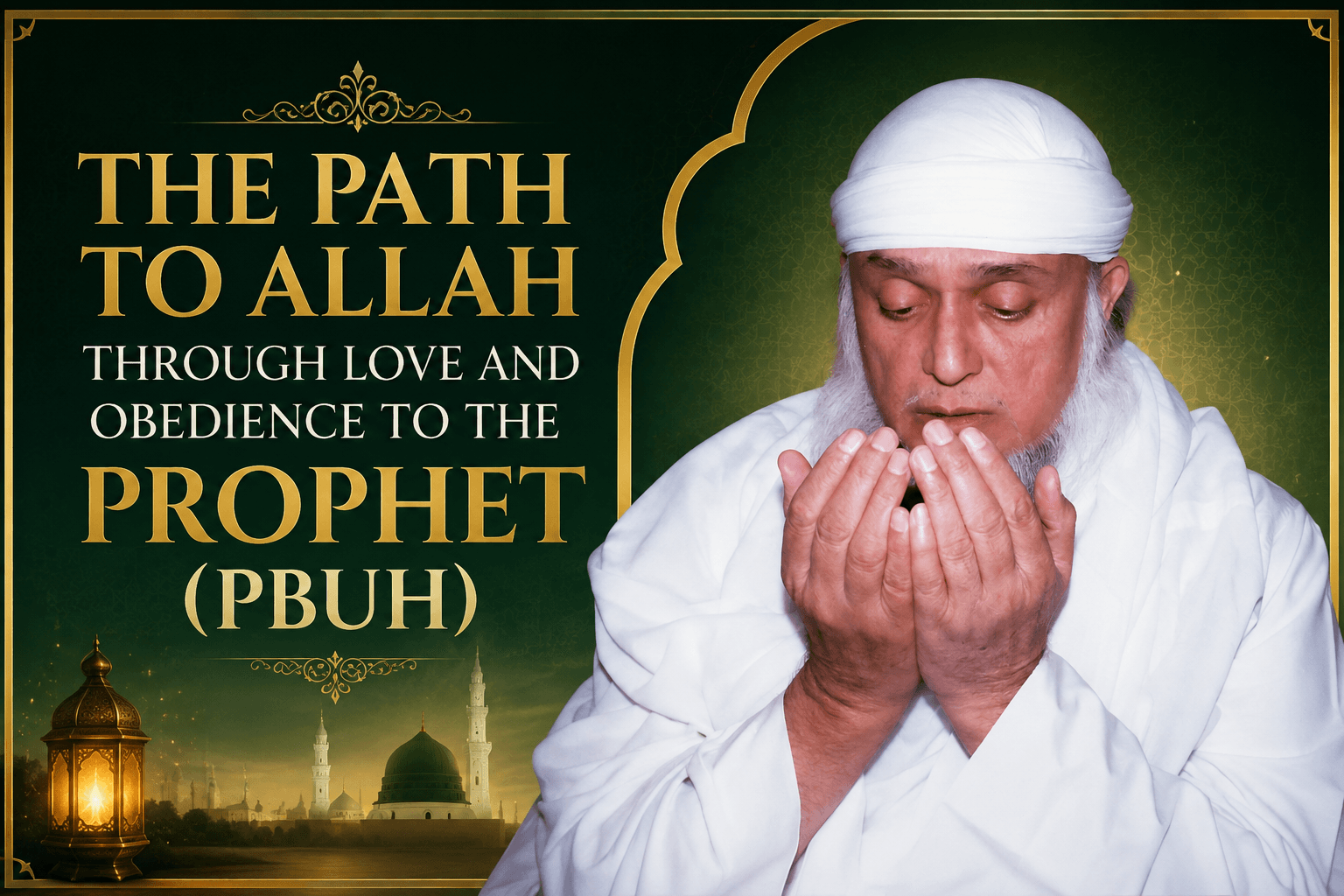
Discourse of Huzoor Wala Shan Pir Sahib (RA)
Date: 28 December 1985
Discourse No. 38
﷽
فَنِعۡمَ الۡمَوۡلٰی وَ نِعۡمَ النَّصِیۡرُ
رَبِِّ اشۡرَحۡ لِیۡ صَدۡرِیۡ وَیَسِّرۡ لِیۡۤ اَمۡرِیۡ وَ احۡلُلۡ عُقۡدَۃً مِّنۡ لِّسَانِیۡ یَفۡقَہُوۡاقَوۡلِیۡ
اَللّٰهُمَّ صَلِ عَلٰی سَیّدِنَا مُحَمَّدٍوَّعَلٰی اٰلِ سَیِّدِنَا مُحَمَّدٍوَّعَلٰی اَصْحَابِہٖ وَعَلٰی اَذْوَاجِہٖ اَجْمَعِیْنَ وَبَارِکْ وَسَلِمْ وَصَلِ عَلَیْہٖ
All praise is for Allah.
Countless thanks to Allah Almighty, the Sovereign Lord, Who has once again granted us the opportunity and the privilege to gather here for His pleasure, in His remembrance, and in His love. Millions upon millions of blessings and peace be upon the Leader of all Prophets, the Beloved of Allah, Prophet Muhammad (PBUH), through whose blessed mediation these divine favors have reached us.
Brothers on the spiritual path!
Before we begin the recitation of the Awrad-e-Pak, it is essential to understand one or two important principles.
Whatever act of worship a believer performs, the only means by which it reaches the Divine Court and attains acceptance before Allah is love for Prophet Muhammad (PBUH). This is the only gateway through which a person becomes a true servant of Allah, a devoted follower of His Messenger, and a sincere Muslim. Every other path ultimately leads a person away from Allah.
It is among the greatest misfortunes of humanity that the very means Allah Almighty has appointed for our guidance, forgiveness, and nearness to Him has been neglected by many, who mistakenly consider avoiding it to be the path of guidance. Some have gone even further, falsely labeling reverence for and devotion to the Messenger of Allah (PBUH) as shirk (associating partners with Allah). Such thinking is nothing but a deception inspired by Satan.
The Holy Qur’an contains numerous verses in which Allah commands believers to love His Messenger, for therein lies their salvation. Allah promises His love for those who love His Messenger. He commands the believers to obey His Messenger, to follow his instructions, and even declares that whoever refuses to obey the Messenger of Allah is among those who reject the truth.
It is therefore necessary to understand the true meaning of shirk. Shirk is to believe that someone other than Allah is the Creator, or to consider anyone equal to Allah in worship and deserving of the same devotion.
Reflect upon this carefully. The greatest act of worship is Salah (prayer), yet the prayer itself is not accepted unless the blessings upon the Messenger of Allah (PBUH) are recited within it. The inclusion of his blessed name and the acknowledgment of his lofty status in the prayer do not constitute shirk; rather, they are an essential part of worship itself.
While reciting Surah Al-Fatihah, the worshipper stands humbly before Allah alone and proclaims:
“O Allah! You alone we worship, and You alone we ask for help.”
At the same time, he also supplicates:
“O Allah! Accept my worship. Guide me upon the path of Your Beloved Messenger Muhammad (PBUH). Keep me away from those who incurred Your displeasure because they rejected obedience to Your Messenger, and protect me from following their ways and their false teachings.”
After completing the prayer, the believer again turns to Allah and prays:
“O Allah! Increase Your mercy and peace upon the Messenger whom You love so dearly, whom You have elevated to the highest rank, and through whose love You love Your servants. Include us among those who sincerely love, honor, and remain loyal to him, so that we may become worthy of Your love and be purified from our sins.”
Remember well!
The Holy Qur’an repeatedly commands obedience to Prophet Muhammad (PBUH), yet nowhere does Allah place conditions upon that obedience. Read the entire Qur’an carefully and you will find that Allah commands unconditional devotion and obedience to His Messenger. He declares that whoever refuses this obedience will face the fate of those who reject faith.
Allah says that whatever the Messenger gives you, accept it; whatever he commands, obey it; and whatever he forbids, refrain from it. This clearly demonstrates that Prophet Muhammad (PBUH) is protected from error by Allah, making obedience to him complete obedience to Allah.
Love and obedience to the Prophet (PBUH) are themselves acts of worship. Indeed, they occupy an even higher rank, because after performing an act of worship, a person may still wonder whether Allah has accepted it. However, Allah Himself promises His love for those who sincerely love and obey His Beloved Messenger, and therefore their rank becomes even greater.
Reflect carefully once more.
Shirk would be to believe—Allah forbid—that Prophet Muhammad (PBUH) is our Creator, or to regard him as the son of God, just as some Christians did regarding Prophet Isa (Jesus), or as some Jews falsely claimed concerning Prophet Uzair (Ezra), peace be upon him.
No Muslim can even imagine such beliefs.
Rather, every Muslim considers love for the Messenger of Allah (PBUH), reverence for him, and complete devotion to him to be an obligation and the means of salvation, because Allah Himself has commanded it and has chosen him as His most beloved servant.
Allah alone created Prophet Muhammad (PBUH), created the entire universe, and He alone is the All-Powerful. Pleasing Allah and loving Him constitute the essence of Islam. The way to attain Allah’s pleasure is to obey completely the one whom Allah Himself has declared to be His Beloved, for Allah has purified him from every imperfection.
Therefore, obedience, reverence, and love for Prophet Muhammad (PBUH) are in reality obedience, reverence, and love for Allah. Wherever Allah commands respect, obedience, and submission, He also commands obedience to His Messenger. Those who attempt to separate Allah from His Messenger are wrongdoers who disobey Allah.
Allah is Allah, and Mustafa (PBUH) is Mustafa—the Beloved and Chosen Servant of Allah.
In the Name of Allah, the Most Gracious, the Most Merciful
The Awrad-e-Naziriyyah Sharif was then recited, followed by a concluding supplication.