The Path to Allah’s Love Through Following the Prophet (PBUH)
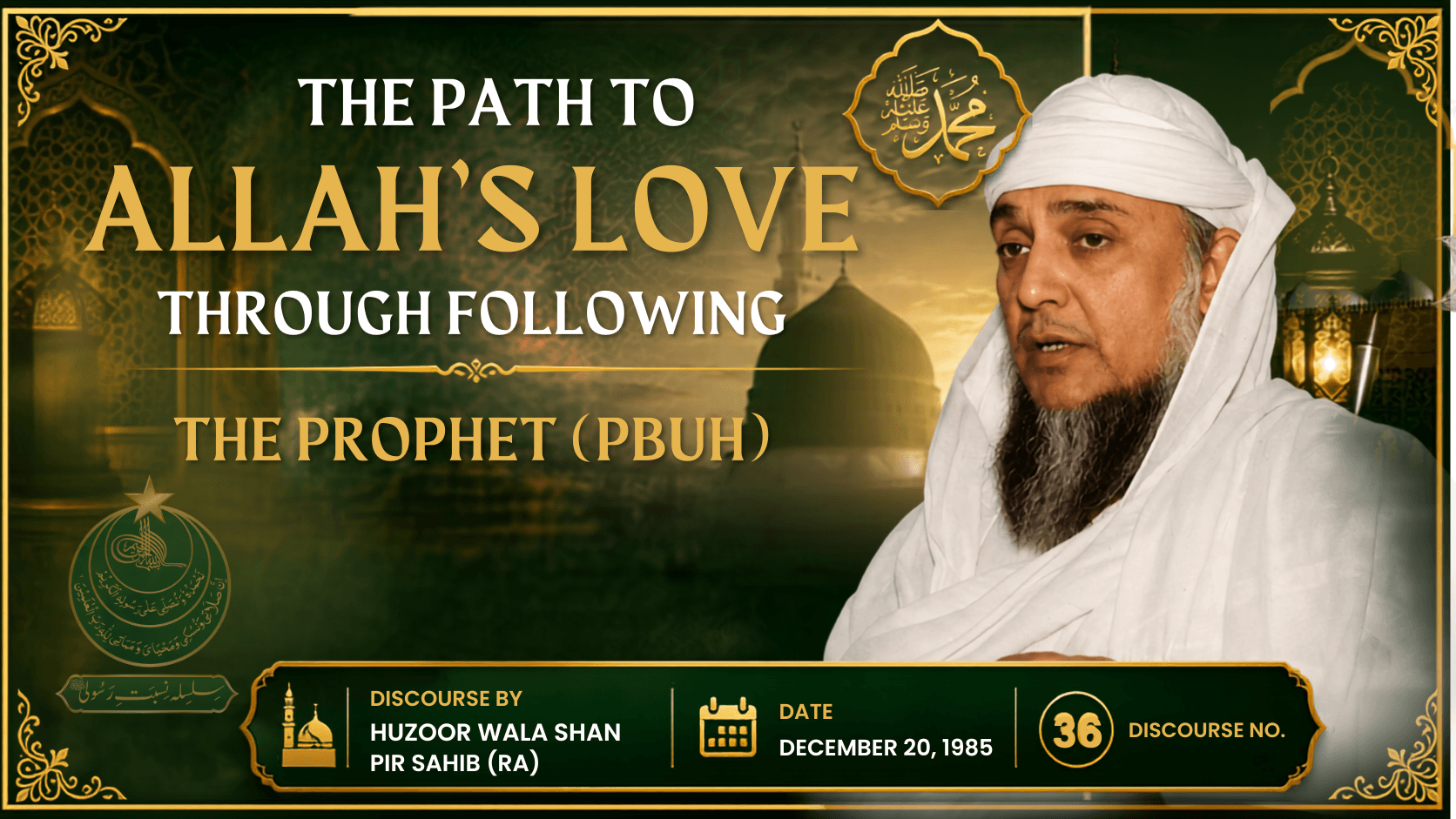
Discourse by Huzoor Wala Shan Pir Sahib (RA)
Date: December 20, 1985
Discourse No. 36
﷽
فَنِعۡمَ الۡمَوۡلٰی وَ نِعۡمَ النَّصِیۡرُ
رَبِِّ اشۡرَحۡ لِیۡ صَدۡرِیۡ وَیَسِّرۡ لِیۡۤ اَمۡرِیۡ وَ احۡلُلۡ عُقۡدَۃً مِّنۡ لِّسَانِیۡ یَفۡقَہُوۡاقَوۡلِیۡ
اَللّٰهُمَّ صَلِ عَلٰی سَیّدِنَا مُحَمَّدٍوَّعَلٰی اٰلِ سَیِّدِنَا مُحَمَّدٍوَّعَلٰی اَصْحَابِہٖ وَعَلٰی اَذْوَاجِہٖ اَجْمَعِیْنَ وَبَارِکْ وَسَلِمْ وَصَلِ عَلَیْہٖ
All praise is for Allah.
Countless thanks to Allah Almighty, the Sovereign of all creation, Who has once again granted us the opportunity to gather here for His pleasure, in His remembrance, and in His love. Countless blessings and peace be upon the Leader of all Prophets, the Beloved of Allah, Prophet Muhammad (PBUH), through whom these immense blessings have reached us.
Respected attendees!
We shall now begin the recitation of the Awrad-e-Pak. Before doing so, there are a few important points to understand.
Always remember that Allah Almighty has created the universe in such a way that every task is accomplished through a means. Nothing happens by itself. Likewise, Allah has established a means through which His creation can attain His love and be accepted in His Divine Love. That means is explained in the Holy Qur’an:
قُلْ اِنْ كُنْتُمْ تُحِبُّوْنَ اللّٰهَ فَاتَّبِعُوْنِيْ يُحْبِبْكُمُ اللّٰهُ وَيَغْفِرْ لَكُمْ ذُنُوْبَكُمْ ۭوَاللّٰهُ غَفُوْرٌ رَّحِيْمٌ
“Say, O Muhammad (PBUH): If you truly love Allah, then follow me; Allah will love you and forgive your sins. And Allah is Most Forgiving, Most Merciful.”
(Surah Aal-e-Imran 3:31)
There are several important lessons in this Divine command.
The first is that this proclamation is not limited to a particular individual or group. It is addressed to every living soul until the Day of Judgment. From Prophet Adam (AS) until the end of time, whoever wishes to attain Allah’s love must follow Prophet Muhammad (PBUH), walk upon his blessed path, and accept him as the leader of mankind.
Prophet Adam (AS) was granted forgiveness only after he learned the words “La ilaha illallah Muhammadur Rasulullah” and sought Allah’s mercy through the blessed status of Prophet Muhammad (PBUH).
On the other hand, Satan was condemned despite worshipping Allah for forty-nine thousand years because he failed to recognize the true rank and value of “La ilaha illallah Muhammadur Rasulullah.” Thus, he became eternally ruined. The word Shaytan signifies one who is ruined or one who leads others to ruin.
On the Day of Judgment, when every person will be concerned only about themselves, humanity will first approach Prophet Adam (AS), requesting him to intercede before Allah. He will decline out of humility. Then they will go to Prophet Nuh (AS), Prophet Ibrahim (AS), Prophet Musa (AS), and Prophet Isa (AS). Each of them will excuse themselves.
Finally, Prophet Isa (AS) will direct everyone to Prophet Muhammad (PBUH), saying that on that Day only his intercession will be accepted.
People will then come before Prophet Muhammad (PBUH), who will declare, “Yes, I shall intercede.”
The Prophet (PBUH) will prostrate before Allah. Allah will say:
“O Muhammad! Raise your head and intercede.”
The Prophet (PBUH) will continue to intercede, and Allah will continue to forgive. He will be granted Maqam Mahmood (the Praised Station) and entrusted with the banner of intercession.
In short, from the beginning of creation until its end, Prophet Muhammad (PBUH) is the divinely appointed means through which mankind attains the love of Allah.
The second lesson is that Allah does not merely accept the love of those who follow His Messenger (PBUH); rather, He Himself loves them. This is an honor far greater than simply having one’s love accepted.
The third lesson is that after granting them His love, Allah also forgives all their sins. The verse does not distinguish between minor or major sins, nor between few or many. What an extraordinary rank has been granted to those who sincerely follow and serve Prophet Muhammad (PBUH)!
Those who claim that devotion or obedience to the Prophet (PBUH) is shirk (associating partners with Allah), or that such obedience is unnecessary, deprive themselves of the very means through which Allah’s love is attained. Consequently, they also lose the immense reward promised by Allah.
The fourth lesson is that when the Lord generously offers His blessings and a servant rejects them, that rejection earns Allah’s displeasure instead of His favor. This was the fate of Satan, who, after 49 thousand years, rather than honoring the blessed name and rank of Prophet Muhammad (PBUH), he showed arrogance and disrespect, leading to his eternal destruction. Those who adopt the same attitude not only ruin themselves but also spread that misfortune among others.
Respected attendees!
It was the Beloved Messenger of Allah (PBUH) who taught us these blessed Awrad. They are a means of seeking Allah’s mercy, asking His forgiveness, requesting love for Allah and His Messenger (PBUH), and praying for steadfastness in serving and following them.
Therefore, recite these sacred supplications with complete attention, sincerity, and devotion, praying that Allah accepts them and grants us the honor of keeping them upon our tongues for as long as we live.
In the Name of Allah, the Most Gracious, the Most Merciful
The Awrad-e-Naziriyyah Sharif were then recited, followed by a concluding supplication.