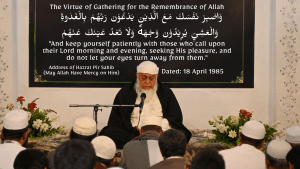
Trust in Allah: Lessons from the Story of Prophet Yusuf (AS)

Discourse of Huzoor Wala Shan Pir Sahib (RA)
Dated: 1 November 1985
Speech No. 30
بِسْمِ اللّٰهِ الرَّحْمٰنِ الرَّحِیْمِ
فَنِعۡمَ الۡمَوۡلٰی وَ نِعۡمَ النَّصِیۡرُ
رَبِِّ اشۡرَحۡ لِیۡ صَدۡرِیۡ وَیَسِّرۡ لِیۡۤ اَمۡرِیۡ وَ احۡلُلۡ عُقۡدَۃً مِّنۡ لِّسَانِیۡ یَفۡقَہُوۡاقَوۡلِیۡ
اَللّٰهُمَّ صَلِ عَلٰی سَیّدِنَا مُحَمَّدٍوَّعَلٰی اٰلِ سَیِّدِنَا مُحَمَّدٍوَّعَلٰی اَصْحَابِہٖ وَعَلٰی اَذْوَاجِہٖ اَجْمَعِیْنَ وَبَارِکْ وَسَلِمْ وَصَلِ عَلَیْہٖ
All praise is for Allah.
Countless thanks be to Allah, the Lord of all dominion, Who has once again granted us the opportunity and blessing to gather here for His pleasure, in His remembrance, and in His love. May millions upon millions of blessings and peace be upon the Leader of the Prophets, the Beloved of Allah, Hazrat Muhammad Mustafa (peace and blessings be upon him), through whose blessed mediation we have received this favor.
Qur’an – Surah Yusuf (12:111)
لَقَدْ كَانَ فِيْ قَصَصِهِمْ عِبْرَةٌ لِّاُولِي الْاَلْبَابِ
Translation:
“Indeed, in their stories there is a lesson for people of understanding.”
Those who lack understanding do not reflect, and their condition becomes similar to that of animals.
The story of Prophet Yusuf (Joseph, peace be upon him) is found in Surah Yusuf. A significant portion of the Holy Qur’an consists of the accounts of Allah’s righteous and chosen servants so that people of wisdom may learn lessons from them. Even a single verse from Surah Yusuf contains profound guidance that could require a great deal of time to explain. Today, however, I will briefly mention a few points so that those present may benefit from them, and so that the recitation of the sacred Awrad that follows may also bring them spiritual benefit.
Almost every Muslim is familiar with the story of Prophet Yusuf (peace be upon him). Everyone knows the immense hardships he endured. Likewise, Prophet Ya’qub (Jacob, peace be upon him) spent nearly eighty years grieving over the separation from his beloved son. He wept so much that his eyesight turned white. It was an extremely painful period of sorrow.
What appears remarkable is that while Prophet Yusuf (peace be upon him) was eventually rescued from all hardships and became the honored ruler of Egypt, Prophet Ya’qub (peace be upon him) continued to suffer in longing and grief. At first glance, this seems difficult to understand. A father who loved one son so deeply that the jealousy of his other sons drove them to plot against him remained in unbearable sorrow, while Yusuf (peace be upon him), despite knowing how much his father suffered, lived in comfort and authority.
However, when one reflects deeply upon this event, it reveals a profound lesson.
It is narrated that when Prophet Ya’qub (peace be upon him) finally met Prophet Yusuf (peace be upon him), he noticed a bundle of papers beside him and asked:
“O Yusuf! You had so many sheets of paper with you, yet you could not send even a single letter to your father who was yearning for you?”
Prophet Yusuf (peace be upon him) replied:
“Whenever I intended to write, Angel Jibril (Gabriel, peace be upon him) came and stopped me.”
Prophet Ya’qub (peace be upon him) then asked Angel Jibril why he had prevented this. Jibril replied:
“I only carry out the command of my Lord. Ask Allah, the Master of all dominion.”
Prophet Ya’qub (peace be upon him) then prayed:
“O Lord! I remained in such grief and distress. Why did You prevent Yusuf from writing to me and leave me in such sorrow?”
Allah Almighty replied:
“This was a consequence for the words you once spoke. When Yusuf’s brothers asked to take him with them, you said: وَاَخَافُ اَنْ يَّاْكُلَهُ الذِّئْبُ
‘I fear that a wolf may devour him.’ You were My servant, yet you feared the wolf instead of placing your trust in Me.”
Dear attendees, reflect carefully on this. When Yusuf’s brothers requested permission to take him with them, Prophet Ya’qub (peace be upon him), out of intense fatherly love, expressed his fear that a wolf might attack him. In that moment of overwhelming affection, he momentarily overlooked the greater expression of trust, which would have been to entrust Yusuf entirely to Allah, saying that Allah is his Protector. Whoever is under Allah’s protection cannot be harmed by a wolf or by any power in this world.
The lesson we derive is that when a person truly believes in Allah, his faith becomes complete only when he entrusts every matter to Him. A believer should never consider himself independent or anyone else as the ultimate source of help. Everything should be entrusted to Allah alone.
The one who firmly believes that none besides Allah is the true Owner and Master should always remain careful that neither his words nor his actions go against the will of Allah. As for everything else, it should be left to Allah. Such a person’s every action becomes an act of worship, and everything belonging to him remains under Allah’s protection.
There is another important lesson.
When Prophet Yusuf (peace be upon him) was reunited with his father and his brothers, and the truth of what had happened became clear, his brothers were filled with regret and remorse. They were the children of a Prophet and believed in the Day of Judgment. They realized that their salvation lay in seeking Allah’s forgiveness.
Surah Yusuf (12:97)
قَالُوْا يٰٓاَبَانَا اسْـتَغْفِرْ لَنَا ذُنُوْبَنَآ اِنَّا كُنَّا خٰطِـــِٕـيْنَ
Translation:
“They said, ‘O our father, ask Allah to forgive our sins. Indeed, we have been sinners.’
Prophet Ya’qub (peace be upon him) replied:
Surah Yusuf (12:98)
قَالَ سَوْفَ اَسْتَغْفِرُ لَكُمْ رَبِّيْ ۭ اِنَّهٗ هُوَ الْغَفُوْرُ الرَّحِيْمُ
Translation:
“I shall ask my Lord to forgive you. Indeed, He is the Most Forgiving, the Most Merciful.”
Notice that although the brothers themselves had committed the sin, they requested their father to seek forgiveness on their behalf. They did so because he was one of Allah’s chosen servants, whose tongue was purified from sin and whose supplication was accepted by Allah.
Likewise, Prophet Ya’qub (peace be upon him) did not tell them merely to seek forgiveness on their own. Instead, he said that he himself would pray for them. He understood that those who fear Allah the most are especially honored by Him, and requesting such righteous servants to pray is itself a means of receiving Allah’s mercy.
Similarly, many of you come here carrying your spiritual and worldly needs. These blessed Awrad-e-Naziriyah are recited so that, through their blessings, we may seek forgiveness for our sins before Allah and ask for His mercy and grace.
Therefore, with this understanding and this intention, let us begin the recitation of the sacred Awrad.
In the Name of Allah, the Most Gracious, the Most Merciful.
The Awrad-e-Naziriyah Sharif were recited, followed by a concluding supplication (du’a).