The Power of Supplication, Humility, and Divine Mercy
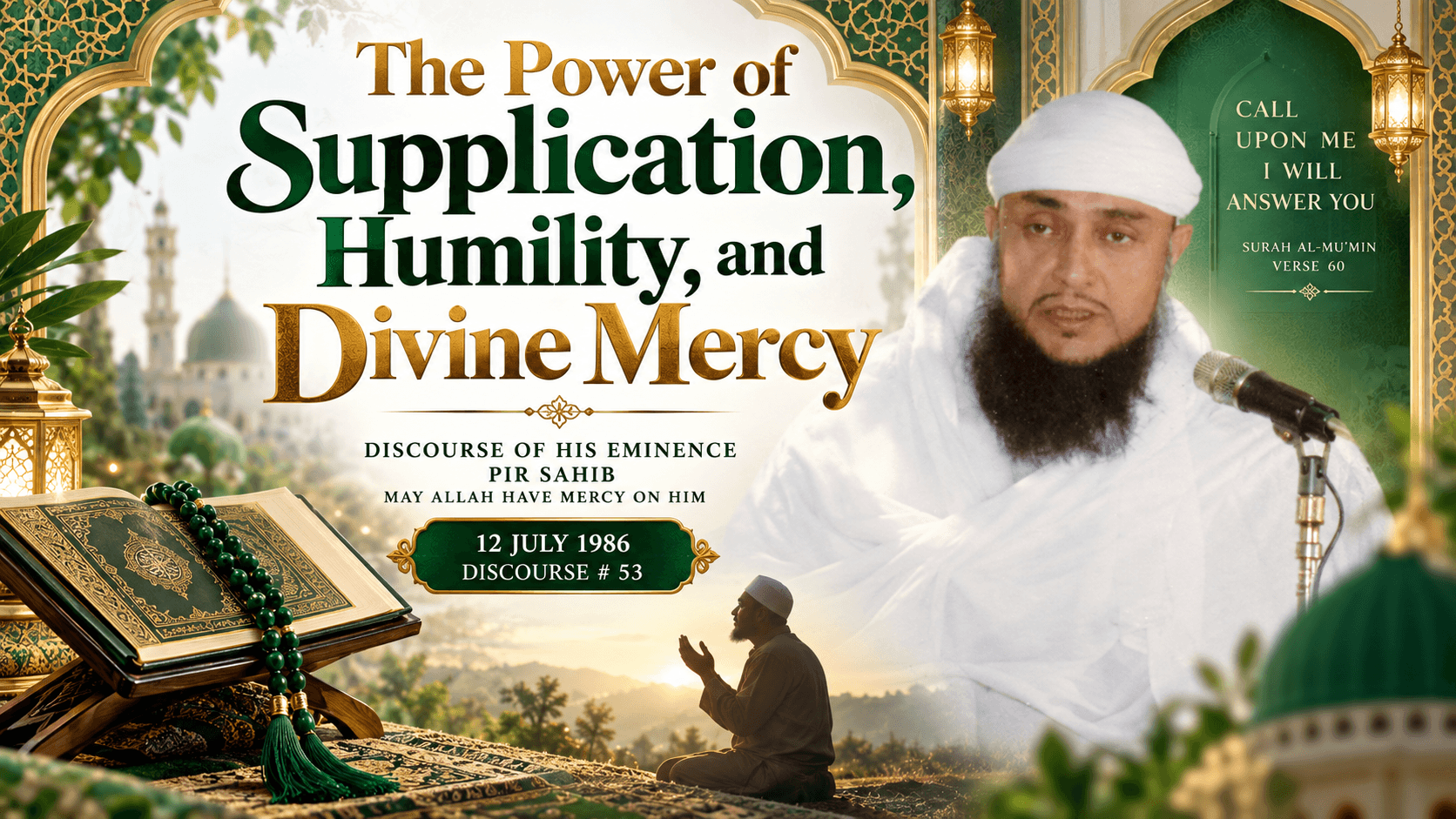
Discourse of His Eminence Pir Sahib, may Allah have mercy on him,
delivered on12 July 1986,
Discourse # 53
بِسْمِ اللّٰهِ الرَّحْمٰنِ الرَّحِیْمِ
فَنِعۡمَ الۡمَوۡلٰی وَ نِعۡمَ النَّصِیۡرُ
رَبِِّ اشۡرَحۡ لِیۡ صَدۡرِیۡ وَیَسِّرۡ لِیۡۤ اَمۡرِیۡ وَ احۡلُلۡ عُقۡدَۃً مِّنۡ لِّسَانِیۡ یَفۡقَہُوۡاقَوۡلِیۡ
اَللّٰهُمَّ صَلِ عَلٰی سَیّدِنَا مُحَمَّدٍوَّعَلٰی اٰلِ سَیِّدِنَا مُحَمَّدٍوَّعَلٰی اَصْحَابِہٖ وَعَلٰی اَذْوَاجِہٖ اَجْمَعِیْنَ وَبَارِکْ وَسَلِمْ وَصَلِ عَلَیْہٖ
ٱلْحَمْدُ لِلّٰهِ
The Almighty Allah be praised that the Master of All Sovereignty once again granted us today the opportunity to gather in His remembrance and pleasure. Millions and billions of blessings and salutations upon the Leader of the Prophets, the Beloved of Allah, Hazrat Muhammad Mustafa, peace and blessings be upon him, through whom this grace has been granted. Respected listeners, the Almighty Allah has said in His noble book:
وَقَالَ رَبُّكُمُ ادْعُوْنِيْٓ اَسْتَجِبْ لَكُمْ ۭ اِنَّ الَّذِيْنَ يَسْتَكْبِرُوْنَ عَنْ عِبَادَتِيْ سَيَدْخُلُوْنَ جَهَنَّمَ دٰخِرِيْنَ
آیت نمبر 60: سورة المؤمن
“And your Lord has said: ‘Call upon Me, and I will answer your supplication.’ Indeed, those who turn away from My worship in arrogance will soon enter Hell, utterly abased.”
Surah Al-Mu’min: Verse #: 60
In this blessed verse, the intent of the Almighty Allah is clear. Whatever the servant has received is through the kindness of the Master. So, no matter how independent he may become in worldly terms, even if every facility and comfort is made available to him, his head should only bow in the presence of Allah. He should continue to remain a petitioner before Allah, and keep asking of Him. Asking Allah is proof that one sees oneself as poor, needy, and humble, while believing Allah to be the Generous Giver the Possessor of limitless treasures. The one who asks believes that only the door of this Master is worthy to be asked, for He has no partner, and only His is the door from which to ask. All these matters are acts of worship. And the greatest act of worship is to always consider oneself needy and Allah as Master. One should keep in heart that all this is His giving, and He can take everything away at any time. When He intends to take His blessings away, no power in the heavens or the earth can help. And if a person performs much worship, he should still see himself and his worship as insignificant. If the thought enters his heart, “I have worshiped a lot” or “I am righteous now,” or “I don’t need any more reward,” then all his worship is wasted, and he may end up among the people of Hell.
Allah has decreed that if anyone stops asking Allah, saying, “I need nothing now,” it means he has fallen into arrogance and begun to consider himself important. Such a person will be made to enter hell. In Sahih al-Bukhari, there is a hadith. Hazrat Anas, may Allah be pleased with him, is the narrator. He relates that there was a man who had never done a single good deed. When he was about to die, he told his heirs, “After I die, burn my body.” “Then scatter half of my ashes in the sea and the other half over the land, for if Allah gains power over me, He will surely punish me with a punishment such as He has not inflicted upon anyone in all the worlds.” He died, and his family carried out his will. Then Allah commanded the sea, and the sea gathered together the scattered ashes within it. And the land gathered together all the ashes scattered upon it. Thereafter, Allah asked that man, “Why did you do this?” He replied, “O my Lord, it was out of fear of You.” And You know best. So, Allah, exalted be He, forgave him.
The narration continues. Hazrat Abu Hurairah, may Allah be pleased with him, is the narrator. He said, “I heard the Messenger of Allah, peace be upon him, say: ‘Among the Children of Israel there were two men who were close friends. One exerted himself greatly in worship, while the other continued committing sins. The worshiper would repeatedly forbid his sinful friend, but he would respond, ‘That is between me and my Lord.’ One day, the worshiper found his sinful friend committing a grave sin. He said, ‘By Allah, Allah will never forgive you.’ When both died and were gathered before Allah, He commanded the angels, ‘Take the worshiper to Hell and the sinner to Paradise.’ And He said to the worshiper, ‘Were you able to withhold My mercy from My servants?’ Hazrat Abu Hurairah said, ‘By Allah, those words destroyed that servant.
It became clear that only the love of God and the fear of God are the means of salvation, and only that worship is accepted in which there is humility, fear, and love. Any worship tainted by pride is wasted. In this worldly life, one should keep asking one’s merciful and generous Lord, for at every moment human beings depend on His kindness. Not only the living, but even the dead rely on His mercy. It is mentioned in the blessed Hadith that the one in the grave is like a drowning person calling for help, waiting for a prayer for forgiveness to reach him, whether from a parent, a brother, or a friend. That prayer is more precious to him than anything in this world. And through the prayers of those who live on earth, God Almighty grants the people of the graves a reward as great as a mountain. This is the gift the living give to the dead—those prayers for forgiveness be offered for them. The proper way to pray is to remember Almighty God with humility and sincerity, turning away from everything of this world, trusting in His mercy, sending blessings upon His beloved messenger, and then presenting one’s request before His presence. In this way, His mercy is stirred, and the one who asks does not return empty-handed.
Now let us begin.
بِسْمِ اللّٰهِ الرَّحْمٰنِ الرَّحِیْمِ
In the name of Allah, the Most Compassionate, the Most Merciful.
The Awrād-e-Naẓīriyyah Sharīf were recited, and supplication was offered.