The Signs of True Faith
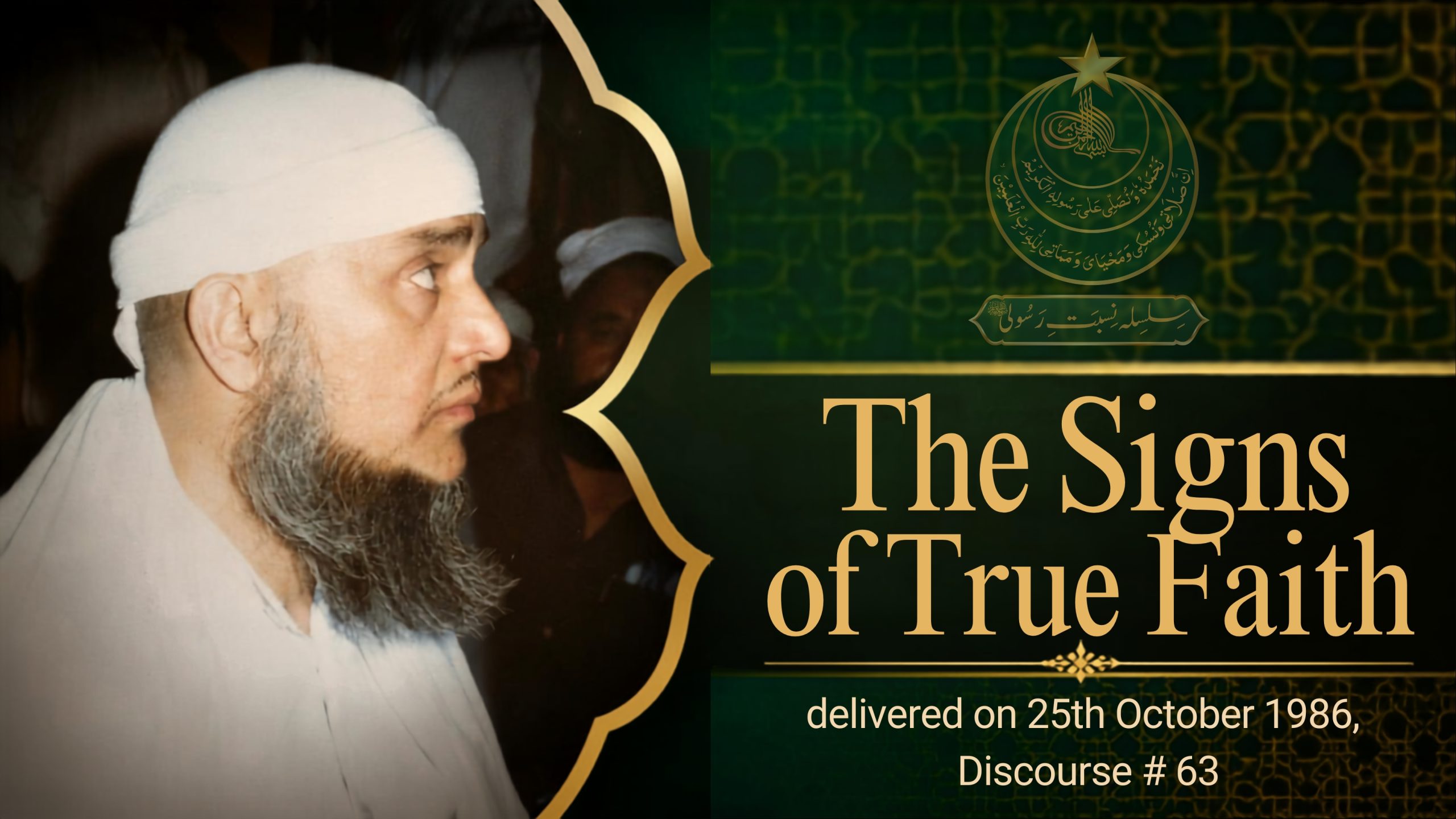
Discourse of His Eminence Pir Sahib, may Allah have mercy on him,
delivered on 25th October 1986,
Discourse # 63
بِسْمِ اللّٰهِ الرَّحْمٰنِ الرَّحِیْمِ
فَنِعۡمَ الۡمَوۡلٰی وَ نِعۡمَ النَّصِیۡرُ
رَبِِّ اشۡرَحۡ لِیۡ صَدۡرِیۡ وَیَسِّرۡ لِیۡۤ اَمۡرِیۡ وَ احۡلُلۡ عُقۡدَۃً مِّنۡ لِّسَانِیۡ یَفۡقَہُوۡاقَوۡلِیۡ
اَللّٰهُمَّ صَلِ عَلٰی سَیّدِنَا مُحَمَّدٍوَّعَلٰی اٰلِ سَیِّدِنَا مُحَمَّدٍوَّعَلٰی اَصْحَابِہٖ وَعَلٰی اَذْوَاجِہٖ اَجْمَعِیْنَ وَبَارِکْ وَسَلِمْ وَصَلِ عَلَیْہٖ
الحمد للہ
All Praise be to Allah Almighty
A hundred thousand thanks are due to Allah Almighty, the Exalted in Majesty, who has granted us once again this day the blessing and opportunity to gather here for His pleasure, in His remembrance and in His love. Countless blessings and peace be upon the Leader of the Prophets, the Beloved of God, our master Muhammad Mustafa, upon whom be peace, through whose noble mediation this immense grace has reached us.
Esteemed listeners, Allah the Exalted has said in the Holy Qur’an:
‘Why do their religious scholars and learned men not forbid them from speaking sinful words and consuming what is unlawful? Truly evil is what they have been doing.’
Surah Al-Ma’idah, verse 63
This means that preaching the faith, forbidding evil, and encouraging good are duties that are undoubtedly incumbent upon Messengers. After them, these duties fall upon their deputies — those who love Allah Almighty and seek His pleasure — among whom are the dervishes and the scholars. In every age, people have continued to forget the divine teachings brought by the Prophets… And they turned toward worldly things and began doing things that were completely opposed to the true teachings. In this way, by disobeying the commands of Allah, they incur loss in this world and in the Hereafter. Therefore, Allah has commanded that whenever a person sees such deeds, it is incumbent upon him to stop them. First with his hand; if not, then with his tongue; and if not, then to regard them as evil in his heart. This is the command conveyed in the blessed hadith of the Holy Prophet, peace be upon him, which states that those who merely regard evil as wrong in their hearts are weak in faith… Those who call themselves men of Allah — whether devout worshippers, ascetics, or scholars who preach the religion — commit a very grave sin in the sight of Allah if they do not forbid such evil. Allah’s displeasure and punishment descend upon such people in the same way as they descend upon the sinners.
Malik bin Dinar relates that once Allah Almighty commanded His angels to destroy a certain settlement. The Angels submitted, ‘O Allah, in that settlement, there is such-and-such a servant of Yours who is devoted to worship.’ The command came, ‘Let him also taste the punishment, for even after witnessing disobedience to Me and the sins being committed, he never became angry, nor did his face ever change with displeasure.’ It was revealed by Allah Almighty to Prophet Yusha bin Nun that a hundred thousand people from his nation would be destroyed by punishment. Among them would be forty thousand righteous people and sixty thousand evildoers. Prophet Yusha submitted, ‘O Lord of all the worlds, the reason for the destruction of the evildoers is evident, but why are the righteous being destroyed?’ Allah Almighty said, ‘These righteous people also maintained friendly relations with the evildoers. They joined them in eating, drinking, laughter, and amusement. Even when they witnessed disobedience to Me, not even the slightest sign of displeasure appeared on their faces.
Respected listeners! If you observe the world today, you will see how the creation of Allah benefits from His blessings, and yet remains engaged in disobedience to Him. They do not even think that they will be called to account for these blessings. The sooner the reckoning comes in this world and the Hereafter, the more lenient it will be; and the longer it is delayed, the more severe it will be. There are people who understand that all of this is very wrong, but setting aside the pleasure of Allah and fearing people’s disapproval, remain silent. They willingly tolerate people’s rebellion or even join in it, and the worship of such people becomes futile. And they become deserving of punishment, because the purpose of worship is to show that a worshipper considers the love of God above all else with all his heart and soul… If, despite worship, a person fears people and does not act upon God’s command, it means that he gives priority to pleasing people. In this way, his worship or knowledge becomes useless, and thus he too becomes deserving of punishment. Therefore, it is necessary that whenever and wherever a person sees something happening against the will of God, he should stop it immediately, as much as he is able. If there is a person who, along with his own worship, guides God’s creation towards God through knowledge and action, and openly expresses displeasure at wrong actions, then as long as such a person is present in a town, God’s punishment will not descend upon it, even if the entire town is sinful. First, that person will be removed, and only then will the punishment descend.
All praise is due to Allah that, by His grace and with the ability He has granted, our efforts are devoted to this very purpose. In a world where creation has forgotten the love of the Creator and is preoccupied with worldly attachments, there are still those who sacrifice everything for the remembrance of Allah Almighty, seeking His help for their difficulties. For every blessing they seek, instead of turning to worldly means, they raise their hands before Allah alone. However much we thank Him for this kindness, it is never enough. In this gathering, Allah Almighty is remembered. We turn to Him with pleas for deliverance from the sorrows of this world and the Hereafter, and ask for the joys and blessings of both worlds. During this blessed act, you should remain conscious that you are remembering your Lord, asking only from Him, considering everything else insignificant, and believing in His absolute power, so that you may fully receive the blessings of this gathering.
Now, let us begin.
بِسْمِ اللّٰهِ الرَّحْمٰنِ الرَّحِیْمِ
In the blessed name of Allah, the Most Compassionate, the Most Merciful.
The Awrād-e-Naẓīriyyah Sharīf were recited, and supplication was offered.