The Blessing of Certainty (Yaqeen) Through the Remembrance of Allah
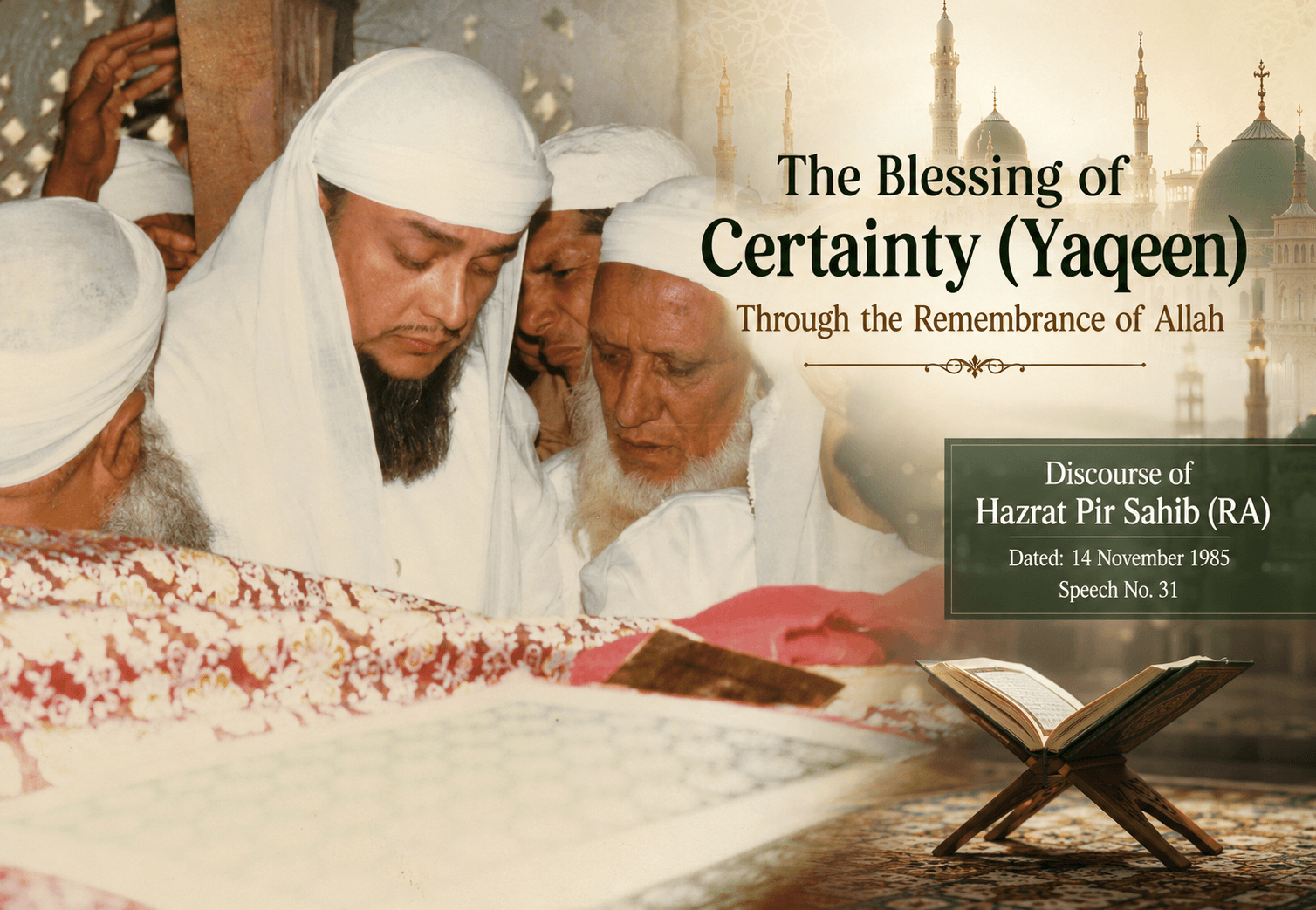
Discourse of Hazrat Pir Sahib (RA)
Dated: 14 November 1985
Speech No. 31
﷽
فَنِعۡمَ الۡمَوۡلٰی وَ نِعۡمَ النَّصِیۡرُ
رَبِِّ اشۡرَحۡ لِیۡ صَدۡرِیۡ وَیَسِّرۡ لِیۡۤ اَمۡرِیۡ وَ احۡلُلۡ عُقۡدَۃً مِّنۡ لِّسَانِیۡ یَفۡقَہُوۡاقَوۡلِیۡ
اَللّٰهُمَّ صَلِ عَلٰی سَیّدِنَا مُحَمَّدٍوَّعَلٰی اٰلِ سَیِّدِنَا مُحَمَّدٍوَّعَلٰی اَصْحَابِہٖ وَعَلٰی اَذْوَاجِہٖ اَجْمَعِیْنَ وَبَارِکْ وَسَلِمْ وَصَلِ عَلَیْہٖ
All praise belongs to Allah.
Countless thanks to Allah, the Lord of Majesty, who has once again granted us the opportunity to gather here for His pleasure, in His remembrance, and in His love. Millions upon millions of blessings and peace be upon the Leader of all Prophets, the Beloved of Allah, Hazrat Muhammad Mustafa ﷺ, through whose noble mediation we have been blessed with this great favor.
Dear respected listeners,
Allah Almighty says in the Holy Qur’an:وَاعْبُدْ رَبَّكَ حَتّٰى يَاْتِيَكَ الْيَقِيْنُ
“And worship your Lord until there comes to you certainty (Al-Yaqeen).”
(Surah Al-Hijr 15:99)
Although this verse is outwardly addressed to the Holy Prophet ﷺ, it would be incorrect to assume that the Prophet ﷺ lacked certainty. Therefore, it is clear that the true intent of this command is directed toward the Ummah of Muhammad ﷺ.
This is one of the subtle styles of the Qur’an: sometimes the apparent addressee is one person, while the intended audience is another. This is a delicate point that deserves careful understanding.
On the surface, the verse appears to mean that worship should continue until certainty is attained, implying that once certainty is achieved, worship is no longer necessary. However, this is not its intended meaning.
Rather, the verse teaches that certainty (Yaqeen) is an immense spiritual treasure that must be pursued with dedication. This certainty is the very essence of true faith, nearness to Allah, and divine recognition (Ma’rifah). To attain this priceless gift, one should engage sincerely in both verbal and physical acts of worship.
When, through sincere devotion, a person is blessed with this great spiritual wealth, all inner impurities, darkness, and spiritual veils that distance one from the remembrance and closeness of Allah are removed. The heart loses its attachment to worldly attractions and bodily desires. True peace, comfort, and tranquility are then found only in the remembrance of Allah.
Without His remembrance, such a person’s life becomes unimaginable. Just as a fish cannot survive without water, a believer who has reached the station of certainty cannot live without worship.
In a Hadith Qudsi, Allah Almighty says:
“My servant continues to remember Me until I become his hearing with which he hears, his sight with which he sees, his hand with which he acts, and his feet with which he walks.”
This means that the servant’s selfish desires and ego are completely subdued, and he becomes illuminated with divine light. Through that light, countless misguided people find the path of guidance.
However, reaching this lofty station of certainty and divine recognition requires purification of the soul (Tazkiyah al-Nafs), and this purification is achieved through the remembrance of Allah. When a person remembers Allah with complete sincerity, Allah blesses him with the priceless gift of certainty.
Respected attendees,
These sacred litanies (Awrad) consist of the beautiful names of Allah. Their purpose is to seek Allah’s help so that He grants us the ability to worship Him sincerely, forgives our mistakes, enables us to perform the deeds that please Him, and guides us upon the path through which His countless blessings may be attained.
Therefore, whenever these sacred Awrad are recited, they should be read with complete sincerity and with this intention firmly established in the heart, so that one may receive their full spiritual benefit.
In the name of Allah, the Most Compassionate, the Most Merciful.
Awrad-e-Naziriyah Sharif were then recited, followed by a concluding supplication (Du’a).