The Blessing of Allah’s Remembrance

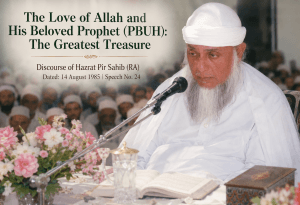
Address of Huzoor Wala Shan Pir Sahib (May Allah Have Mercy on Him)
Dated: 23 March 1985
Speech No:9
بسم اللہ الرحمن الرحیم
فَنِعۡمَ الۡمَوۡلٰی وَ نِعۡمَ النَّصِیۡرُ
رَبِِّ اشۡرَحۡ لِیۡ صَدۡرِیۡ وَیَسِّرۡ لِیۡۤ اَمۡرِیۡ وَ احۡلُلۡ عُقۡدَۃً مِّنۡ لِّسَانِیۡ یَفۡقَہُوۡاقَوۡلِیۡ
اَللّٰهُمَّ صَلِ عَلٰی سَیّدِنَا مُحَمَّدٍوَّعَلٰی اٰلِ سَیِّدِنَا مُحَمَّدٍوَّعَلٰی اَصْحَابِہٖ وَعَلٰی اَذْوَاجِہٖ اَجْمَعِیْنَ وَبَارِکْ وَسَلِمْ وَصَلِ عَلَیْہٖ
All praise is for Allah.
All praise belongs to Allah Almighty. We are immensely grateful to the Lord of all kingdoms, who has once again granted us the opportunity and honor to gather here for His pleasure, in His remembrance, and in His love. Countless blessings and salutations be upon the Leader of the Prophets, the Beloved of Allah, Prophet Muhammad SAWW, through whose grace these blessings have reached us.
Respected listeners!
Once, the Holy Prophet SAWW came out of the mosque holding two books—one in his right hand and the other in his left. The Companions (may Allah be pleased with them all) asked, “O Messenger of Allah SAWW, what is written in these books?”
The Prophet SAWW replied, “The book in my right hand contains the names of the people of Paradise, and the book in my left hand contains the names of the people of Hell.”
The Companions then asked, “O Messenger of Allah SAWW, if the names of the people of Paradise and Hell have already been written, then what is the need for us to worship?”
The Prophet SAWW replied, “Do not worship.”
The Companions returned to their homes. The next morning, when the time for prayer arrived and Hazrat Bilal (RA) called the Adhan, they all rushed back to the mosque. The Prophet SAWW asked, “Why have you come?”
They replied, “O Messenger of Allah SAWW, when we heard the Adhan, our hearts became restless, and we could not stay away.”
The Prophet SAWW said, “This is destiny. Those whose names are among the people of Paradise cannot remain without worship, while those destined for the other path have no inclination toward the remembrance of Allah.”
Alhamdulillah! Even in today’s busy world, people leave behind their occupations and worldly attractions to gather for the remembrance of Allah. Difficulties and hardships do not tire them from returning again and again.
This is truly a blessing from Allah.
“This good fortune is not attained merely through one’s own strength.”
The remembrance of Allah is a tremendous blessing. Allah says:
فَاذْكُرُوْنِيْٓ اَذْكُرْكُم
“So remember Me; I will remember you.” (Surah Al-Baqarah 2:152)
What greater honor can there be than for the Creator and King of all worlds to remember a human being? Therefore, whenever one feels enthusiasm, opportunity, and honor to attend such gatherings, one should thank Allah. However, if attending such gatherings begins to feel burdensome, or worldly engagements seem more important, one should immediately seek forgiveness from Allah and pray:
“O Allah, protect me from this misfortune. Why has the importance of the world become greater in my heart? Why has my desire for these blessed gatherings diminished?”
In reality, whenever a person becomes negligent or commits mistakes in words or actions, the love of the world begins to outweigh the love of Allah. Through sincere repentance, this hardness and darkness of the heart is removed, and the same love and enthusiasm for Allah’s remembrance returns.
As I have mentioned many times before, Allah is not dependent upon anyone’s worship. Whatever acts of worship and goodness a person performs are for his own benefit. If a person does good, Allah blesses him with even more love. But if he becomes negligent, Allah’s displeasure causes the desire for divine remembrance to fade, while worldly love becomes dominant.
Many years ago, in the town of Kahuta, one of our relatives became a Qadiani. His father was a righteous and learned scholar. He became upset and tried repeatedly to persuade his son to return, even resorting to strict discipline, but the son would not listen.
Eventually, the son wrote to Qadian saying:
“My father troubles me greatly. He is a learned scholar. Please send a scholar who can convince him. If he becomes a Qadiani, the entire town of Kahuta will likely follow.”
As a result, four Qadiani scholars came and said:
“We have heard that you are troubling your son because he has become a Qadiani. We wish to explain the truth to you completely.”
The father agreed to discuss the matter.
The visitors said, “It is now evening. Let us hold the debate tomorrow morning. For now, let us make a prayer together: If you are right, we will abandon our faith, and if we are right, you will become a Qadiani.”
The man agreed and joined them in making this prayer.
The next morning, the entire town was shocked to learn that Raja Sahib had become a Qadiani. He later instructed that after his death, his coffin should be taken to Qadian for burial, and this was done.
People were astonished and went in groups to various scholars, who refused to believe the story. Finally, they came to my father, Hazrat Pir Nazir Ahmad Sahib (may Allah have mercy on him), in Rawalpindi and asked for an explanation.
Hazrat Pir Sahib (RA) said:
“The matter is quite clear. When the prayer was made that evening, this man effectively became spiritually misguided at that very moment. By saying, ‘If they are right, I will join their religion,’ he cast doubt upon his own faith. Instead, he should have prayed: ‘O Allah, by Your grace I am upon the true religion; guide these people as well.’ But because he entertained doubt regarding his faith, doubt entered his heart. Allah then allowed that doubt to grow, and he became deeply afflicted by it.”
The lesson is that those who gather here for the remembrance of Allah do so for their own spiritual and worldly benefit. Therefore, they should always thank Allah for this blessing. If negligence overtakes them, they should seek forgiveness and realize that some fault on their part has deprived them of this favor.
Let us therefore invoke the name of Allah and, through His blessed name, pray that Allah keeps us engaged in His remembrance throughout our lives; that when death comes, it finds us remembering Him; and that on the Day of Resurrection, we are raised with His name upon our tongues.
After this, Awrad-e-Naziriyyah Sharif was recited, and a collective supplication was made.