The Importance of Correct Belief in Worship and Trust in Allah
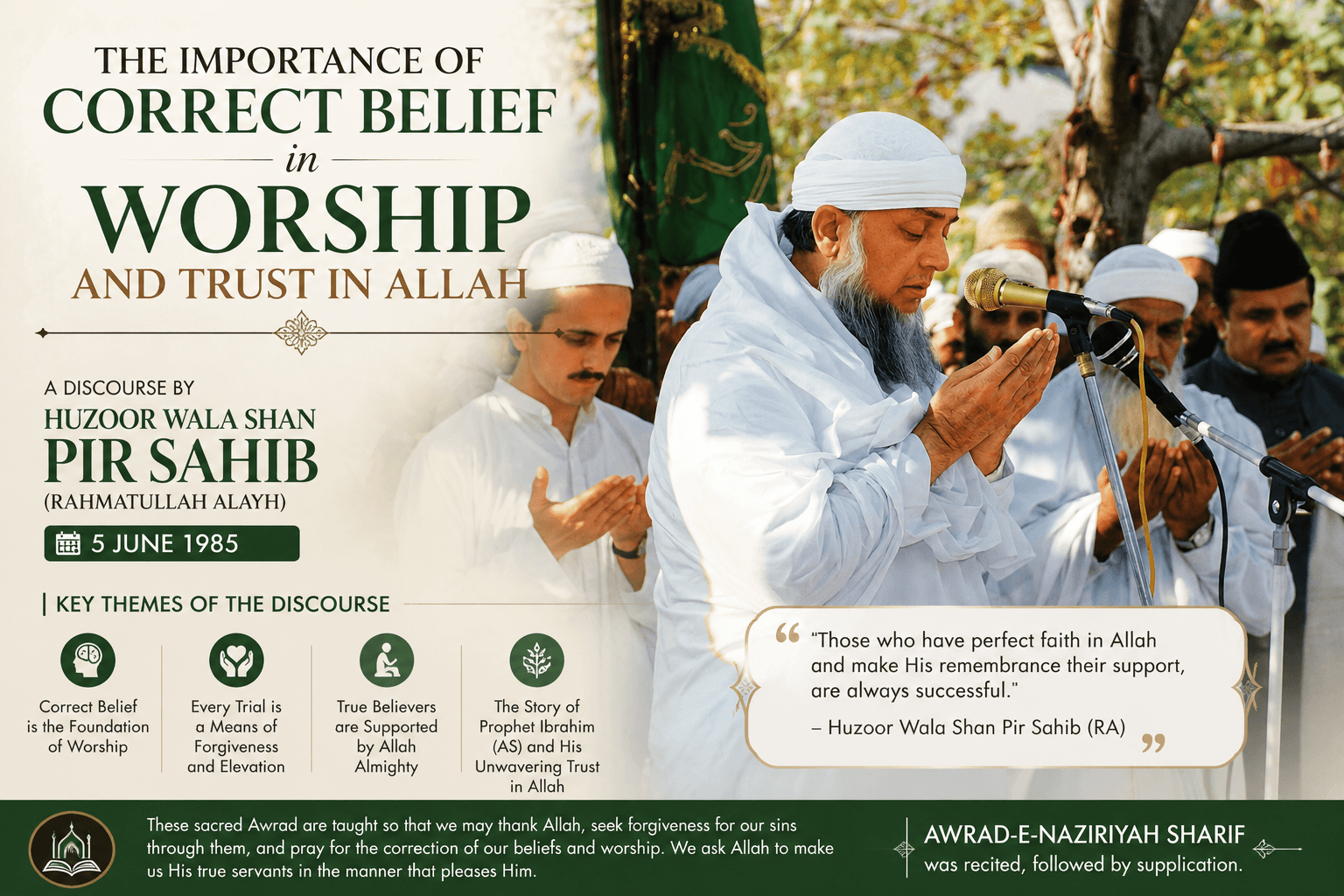
Discourse of Huzoor Wala Shan Pir Sahib (RA)
Dated: 5 June 1985
Speech No. 17
بسم اللہ الرحمن الرحیم
فَنِعۡمَ الۡمَوۡلٰی وَ نِعۡمَ النَّصِیۡرُ
رَبِِّ اشۡرَحۡ لِیۡ صَدۡرِیۡ وَیَسِّرۡ لِیۡۤ اَمۡرِیۡ وَ احۡلُلۡ عُقۡدَۃً مِّنۡ لِّسَانِیۡ یَفۡقَہُوۡاقَوۡلِیۡ
اَللّٰهُمَّ صَلِ عَلٰی سَیّدِنَا مُحَمَّدٍوَّعَلٰی اٰلِ سَیِّدِنَا مُحَمَّدٍوَّعَلٰی اَصْحَابِہٖ وَعَلٰی اَذْوَاجِہٖ اَجْمَعِیْنَ وَبَارِکْ وَسَلِمْ وَصَلِ عَلَیْہٖ
All praise is for Allah.
Countless thanks to Allah Almighty, the Sovereign Lord, Who has once again granted us the opportunity and ability to gather here for His pleasure, in His remembrance, and in His love. Millions and countless blessings and salutations be upon the Leader of the Prophets, the Beloved of Allah, Hazrat Muhammad Mustafa (PBUH), through whose blessed mediation these favors have been bestowed.
Respected listeners! As usual, we shall recite the sacred Awrad (supplications). Before that, it is necessary to understand a few important points.
The matter is that before performing any act of worship or any righteous deed, it is essential to correct one’s belief and thoughts. Otherwise, that deed and worship lose their true value. When belief and understanding are sound, then worship and actions produce the proper results.
Outwardly, a person may appear to possess little knowledge, yet Allah Almighty elevates the reality of such worship and makes it beneficial for the one who performs it.
Sometimes, a person performs righteous deeds and worship with correct belief and understanding, yet still does not perceive the desired results. In reality, this is not the case; rather, it is due to the person’s lack of awareness. The difficulties and obstacles that arise under such circumstances often occur because of those good deeds and acts of worship, and they serve as a means of spiritual elevation and honor.
It is mentioned in the noble Hadith that no hardship befalls a person who truly believes in Allah except that it is for his own betterment. Even if a thorn pricks such a person, it becomes a means of forgiveness for a sin—either one of which he is unaware, or one that otherwise might not have been forgiven—or it becomes the means for some goodness that had been withheld from him.
Those who possess perfect faith in Allah and make His remembrance their support, are always successful. History bears witness to this fact. They themselves may not realize it, yet the entire universe, and every particle within it, remains engaged by Allah’s command in serving and assisting them.
Hazrat Ibrahim (AS) once went to Nimrod to obtain grain, as all people used to do. Nimrod would first ask people, “Who is your lord?” Whoever acknowledged Nimrod’s lordship would be given grain.
During a severe famine, Hazrat Ibrahim (AS) also went to him. Nimrod asked, “Am I your lord?” Hazrat Ibrahim (AS) replied, “No. My Lord is the Owner and Sustainer of both you and me.”
Nimrod said, “I too give life and cause death. I can kill whomever I wish and spare whomever I wish.”
Hazrat Ibrahim (AS) responded, “My Lord causes the sun to rise from the east and set in the west. So, if you are truthful, make it rise from the west and set in the east.”
At this, Nimrod was left speechless and refused to give him any grain.
Hazrat Ibrahim (AS) returned home empty-handed. On the way, he saw a mound of sand and thought, “My family will be distressed to see me return empty-handed. Let me fill the sacks with sand so they will not become disappointed at first sight.”
He filled the sacks with sand and brought them home. Being tired, he placed them down and fell asleep. When he awoke, he found delicious food prepared. He asked her wife Lady Sarah (AS), “Where did this grain come from?”
She replied, “From what you brought.”
Hazrat Ibrahim (AS) looked into the sacks and found them filled with the finest grain. He remained silent and expressed gratitude to Allah Almighty.
These sacred Awrad are taught so that we may thank Allah, seek forgiveness for our sins through them, and pray for the correction of our beliefs and worship. We ask Allah to make us His true servants in the manner that pleases Him, and to remove those shortcomings within us of which we ourselves are unaware.
In the Name of Allah, the Most Gracious, the Most Merciful
Awrad-e-Naziriyah Sharif was recited, followed by supplication.