The True Test of Life: Choosing Allah Above Wealth and Children
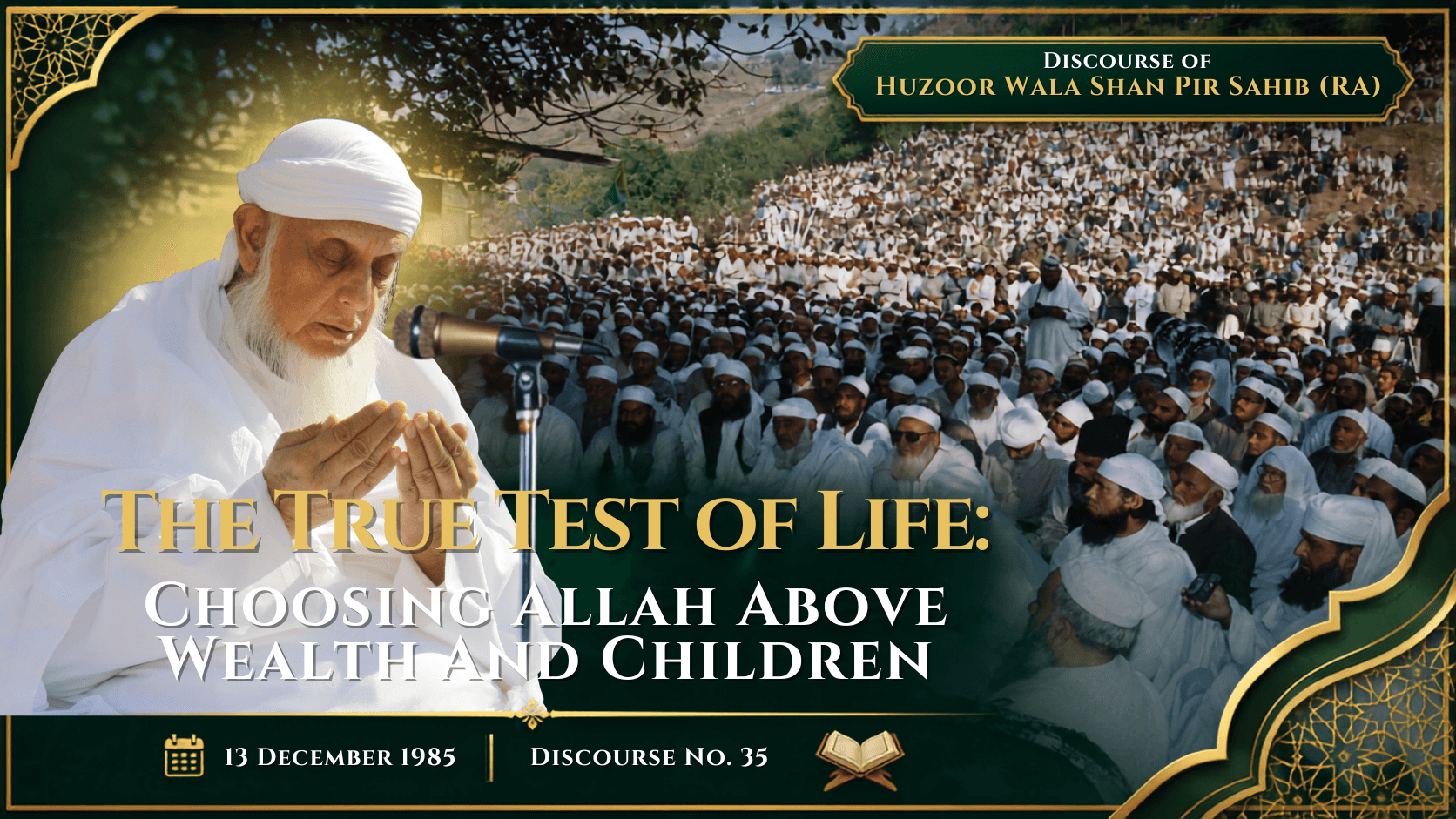
Discourse of Huzoor Wala Shan Pir Sahib (RA)
Date: 13 December 1985
Discourse No. 35
﷽
فَنِعۡمَ الۡمَوۡلٰی وَ نِعۡمَ النَّصِیۡرُ
رَبِِّ اشۡرَحۡ لِیۡ صَدۡرِیۡ وَیَسِّرۡ لِیۡۤ اَمۡرِیۡ وَ احۡلُلۡ عُقۡدَۃً مِّنۡ لِّسَانِیۡ یَفۡقَہُوۡاقَوۡلِیۡ
اَللّٰهُمَّ صَلِ عَلٰی سَیّدِنَا مُحَمَّدٍوَّعَلٰی اٰلِ سَیِّدِنَا مُحَمَّدٍوَّعَلٰی اَصْحَابِہٖ وَعَلٰی اَذْوَاجِہٖ اَجْمَعِیْنَ وَبَارِکْ وَسَلِمْ وَصَلِ عَلَیْہٖ
All praise is for Allah.
Countless thanks to Allah Almighty, the Sovereign of all kingdoms, Who has once again granted us the opportunity to gather in His remembrance, seeking His pleasure and love. Millions upon millions of blessings and peace be upon the Leader of all Prophets, the Beloved of Allah, Hazrat Muhammad Mustafa (PBUH), through whose blessed means these divine favors have reached us.
Dear listeners,
Allah Almighty says in the Holy Qur’an:
وَنَبْلُوْكُمْ بِالشَّرِّ وَالْخَيْرِ فِتْنَةً ۭ وَاِلَيْنَا تُرْجَعُوْنَ
“And We test you with evil and with good as a trial, and to Us you will all be returned.”
(Surah Al-Anbiya 21:35)
This world is a place of examination. Every person is being tested, whether rich or poor, healthy or ill, a king or a beggar, joyful or distressed.
The poor are tested through poverty: Are they content with what Allah has granted them? Do they continue to remember Allah despite their hardship? Likewise, the sick are tested to see whether they remain grateful to Allah during illness.
In the same way, honor and wealth are also forms of trial. However, among the greatest tests are wealth and children.
When Allah blesses a person with children, their love and responsibilities often become so overwhelming that the individual begins to neglect the remembrance of Allah. They forget that these blessings belong to Allah alone. If they remain devoted to Allah, He Himself will grant their children health, knowledge, honor, and prosperity, for He alone possesses all treasures and all authority.
Unfortunately, many people become trapped by Satan and their own desires. As a result, the very children for whom they neglected Allah may become disobedient, unsuccessful, or a source of sorrow and humiliation. They may spend their entire lives regretting their choices, while those children become a lifelong burden of grief for their parents.
On the other hand, those who remain devoted to the Giver rather than the gift find that Allah makes their children a source of happiness in both this world and the Hereafter.
Someone once asked Hazrat Ali (RA),
“What provision have you made for your children?”
He replied,
“I have only advised them never to forget Allah. If they remember Allah, they will always be honored and successful. But if they forget Him, then I have no concern for such children.”
The same principle applies to wealth.
If wealth is regarded as a gift from Allah and spent in His way, it multiplies many times over and becomes a source of blessings in both worlds. However, when a person considers wealth to be solely the result of their own efforts rather than Allah’s favor, it becomes a cause of clear loss (Khusran-e-Mubeen).
The wealth spent on children may produce unworthy heirs. Property may become a source of conflict and hardship. Every passing moment then brings new worries and disappointments. The person remains occupied with these troubles without realizing that the true cause is their attachment to worldly possessions instead of Allah.
Such wealth not only leads to destruction in this life but, on the Day of Judgment, it may become a means of punishment.
Therefore, the correct way to live in this world and to stand honored before Allah in the Hereafter is to keep everything ready to sacrifice for His sake. When a servant offers all that he possesses for Allah, Allah, in return, commands the entire universe to serve that person. Instead of owning a small amount of worldly wealth, he becomes the possessor of limitless divine blessings.
History bears witness that those who gave priority to the love of Allah found every blessing beneficial in this world and the next. But those who became attached to wealth or children and neglected Allah ultimately met an end filled with regret, humiliation, and sorrow.
Hazrat Pir Sahib (RA) once narrated an incident:
The personal driver of King Amanullah of Afghanistan once visited Mohra Sharif. Hazrat Pir Sahib (RA) asked him whether he knew the story behind Amanullah’s downfall.
The driver explained that King Amanullah had planned a tour of Europe. The itinerary included visits to several European cities, followed by a pilgrimage to Makkah and Madinah on the return journey.
However, since it was his first visit to Europe, he became fascinated by its attractions. Wherever he intended to stay for two days, he remained for three or four, causing significant delays.
Eventually, he said,
“Too much time has already been spent. We will plan the pilgrimage to Makkah and Madinah another time. Right now, I am eager to return to my beloved homeland of Afghanistan.”
The driver was traveling at about sixty miles per hour when the king insisted on driving himself. He drove at great speed, and as soon as they crossed into Afghanistan, he stopped the car, stepped out, picked up a handful of his homeland’s soil, kissed it, and breathed a sigh of relief.
After reaching Kabul, he rested.
The very next morning, a revolution erupted.
The same king who had preferred his homeland over Makkah and Madinah was forced to flee in disguise to save his life. The country he loved so dearly did not even provide him a place to hide. He was expelled in disgrace and spent the remainder of his life in exile, eventually passing away far from his homeland.
These sacred litanies (Wazaif) consist of the blessed Names of Allah. They are recited so that, through them, we may humbly supplicate before Allah, saying:
“O Allah! Grant us the understanding and ability to live according to Your will. Keep us alive only for Your pleasure and guide us to spend our lives in obedience to You.”
Now let us begin:
Bismillahir-Rahmanir-Raheem
The Awrad-e-Naziriyah Sharif was then recited, followed by a concluding supplication.