Taqwa: The Key to Relief, Sustenance, and Divine Protection
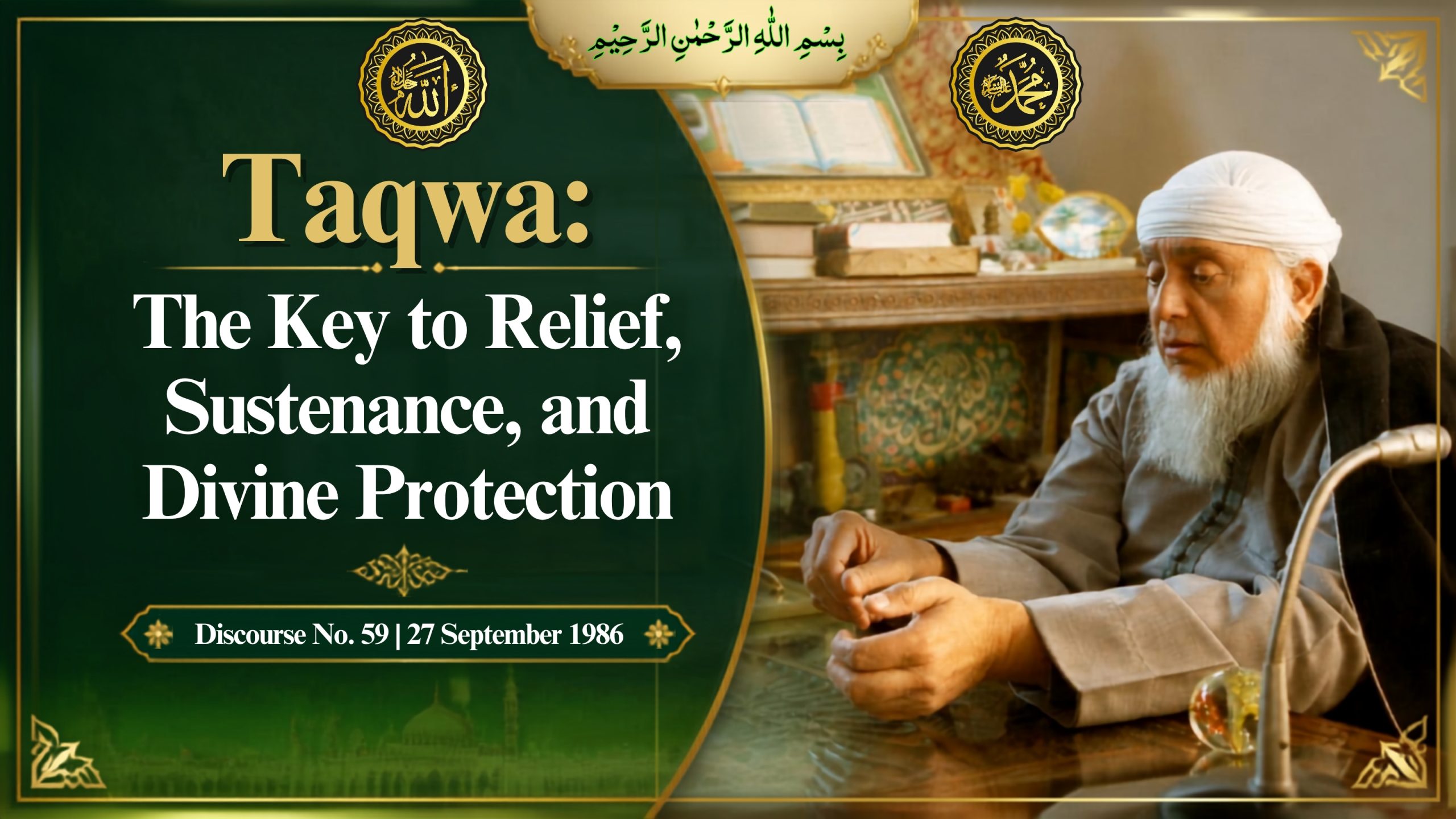
Discourse of His Eminence Pir Sahib, may Allah have mercy on him,
delivered on 27th September1986,
Discourse # 59
بِسْمِ اللّٰهِ الرَّحْمٰنِ الرَّحِیْمِ
فَنِعۡمَ الۡمَوۡلٰی وَ نِعۡمَ النَّصِیۡرُ
رَبِِّ اشۡرَحۡ لِیۡ صَدۡرِیۡ وَیَسِّرۡ لِیۡۤ اَمۡرِیۡ وَ احۡلُلۡ عُقۡدَۃً مِّنۡ لِّسَانِیۡ یَفۡقَہُوۡاقَوۡلِیۡ
اَللّٰهُمَّ صَلِ عَلٰی سَیّدِنَا مُحَمَّدٍوَّعَلٰی اٰلِ سَیِّدِنَا مُحَمَّدٍوَّعَلٰی اَصْحَابِہٖ وَعَلٰی اَذْوَاجِہٖ اَجْمَعِیْنَ وَبَارِکْ وَسَلِمْ وَصَلِ عَلَیْہٖ
الحمد للہ
All Praise be to Allah Almighty
Respected listeners! Allah Almighty has stated in the Holy Qur’an that:
وَمَنْ يَّتَّقِ اللّٰهَ يَجْعَلْ لَّهٗ مَخْرَجًاوَّيَرْزُقْهُ مِنْ حَيْثُ لَا يَحْتَسِبُ
( آیت نمبر 2 تا 3 : سورۃ الطلاق)
Translation:
Whoever fears Allah, He will make a way out for them, and He will provide for them from where they could never have imagined.
(Surah At-Talaq, verses 2–3)
This is something truly worth understanding: the fear of Allah and taqwa are such great blessings, treasures, and sources of strength that, if a person attains them, they are protected from every kind of sorrow and worry, and from every fear. No matter how great the hardship may be, even if it seems impossible to escape from it, and even if the whole world stands against that person—if the fear of Allah is present in their heart, Allah will make a way out for them. He will create a way in such a manner that the person could never have imagined. He will leave everyone amazed and humbled, and through His unseen help, He will grant success to the one who fears Him. This is the promise of Allah, and the promise of Allah can never be false. Whoever doubts this or thinks, “I wonder whether this is really true or not,” goes outside the fold of Islam, because the Qur’an gives such a ruling concerning the one who does not accept the command of Allah. The second message conveyed in this blessed verse is that any person—whether a woman or a man, a child or an elderly person—who fears Allah should never be worried about where their sustenance will come from or who will provide for them. Allah says that such a person should have no anxiety about it. Allah promises that He will provide for them from a source they could neither expect nor imagine. And the promise of Allah is always true.
But there is a condition: a person must have the fear of Allah in their heart and must possess taqwa.
What is the fear of Allah, and what is taqwa—the quality for which Allah, the Almighty, shows such great kindness and mercy? This is something that needs to be understood. The fear of Allah means that a person has a firm conviction that Allah Almighty is the Owner and Creator of everything, that He is One and has no partner, and that everything is under His control. Nothing can take shape or come into existence without His will and command. Allah has set commands and laws, which the Holy Prophet(PBUH) conveyed to us, and all of them are preserved in the form of the Holy Qur’an.
Before following these laws, it is essential to follow and honor the one who conveyed these laws, so that a person may attain the pleasure of Allah and understand the true spirit of His laws. In this way, a person can attain such spirituality that both their outward and inward actions come under the guidance and commands of Allah. If a person claims that they fear Allah, yet shows disrespect towards the Messenger(PBUH), then how can they truly follow and honor the laws brought by him? And if a person does not obey the commands of Allah, then in what sense can they claim to fear Him? Such a person is a hypocrite, and a hypocrite is deserving of a doubled punishment. Therefore, it is essential that if we truly have the fear of Allah in our hearts, then our actions must be in accordance with the commands of Allah. If they are, then we are protected from every sorrow, fear, and anxiety.
But if this is not the case, then dependence upon others from door to door and a life of servitude will be our fate. May Allah protect us from such a state. Na‘udhu billahi min dhalik. After the blessed Prophet(PBUH was sent as the Messenger of Allah, it was made clear to us that if you seek honor, happiness, peace, and protection, they are to be found in holding firmly to the bond of Allah and His Messenger (PBUH)Everything else is merely deception and a mirage.
Sa‘eed ibn Jubayr relates that there was a man from the tribe of Shumaym whose name was Rifa‘ ibn ‘Umair. He narrated the story of how he came to accept Islam and said:
I was traveling through the desert of ‘Alij. When I became overwhelmed by sleep, I stopped my she-camel, got down, and made camp at a place. Then I went to sleep. But before sleeping, I said, ‘I seek the protection of the chief of the jinn of this valley. I saw in a dream that a man had a small spear in his hand and wanted to thrust it into my she-camel’s neck. I woke up alarmed and looked around, but saw nothing. I thought it was just a meaningless dream. I went back to sleep, but then I saw the same dream again. When I woke up, my she-camel was restless. I looked around and saw a young man, just like the one in the dream, with a small spear in his hand. Beside him was an old man holding the young man’s hand and stopping him from killing the she-camel. While the two of them were struggling, three nilgai (antelopes) appeared. The old man said to the young man, ‘Get up, and instead of this traveler’s she-camel, take whichever one of these you wish.’ The young man got up, took hold of a big nilgai (antelope), and went away. I then turned towards the old man. He said, ‘O person! When you camp in a valley and fear any danger there, say, “O Allah! I seek refuge from the dangers of this valley with the Lord of Muhammad, peace and blessings be upon him and his family.” And do not seek the protection of any jinn, for their power has now come to an end.
I asked, ‘Who is Muhammad Mustafa (peace and blessings be upon him and his family)?’ The old man replied, ‘He is a prophet from among the people of Arabia. He is neither of the East nor of the West. He was commissioned with prophethood on a Monday.’ I asked, ‘Where is his place of residence?’ He said, ‘Yathrib, the city of palm groves.’ The following morning, I mounted my ride quickly and reached Medina. As soon as the Messenger of Allah, peace and blessings be upon him and his family, saw me, he recounted my entire experience, even though I had not told him anything. Then he invited me to embrace Islam, and I became a Muslim.
The point of relating this is that Allah Almighty showed us a great favor by sending the Holy Prophet (peace and blessings of Allah be upon him and his family), and made seeking refuge in him the cure for all our worries. Oasis or desert, in today’s world, every step is fraught with danger, and it is a breeding ground for sorrows and anxieties. In this great calamity, we recite those sacred litanies of the Holy God which the Holy Prophet (peace and blessings of Allah be upon him and his family) taught us, and through his intercession we place ourselves under God’s protection, submitting: “O Holy Allah! Our Master, and the sole Creator without partner! By the blessing of these sacred names, and through the intercession of Your Holy Prophet (peace and blessings of Allah be upon him and his family), the one for whom it was said ‘were it not for you’ — keep us in Your protection and safety, save us from the snares of Satan and the base self, save us from the sorrows and anxieties of this world and the next, and grant us the joys of both worlds.
رَبَّنَآ اٰتِنَا فِي الدُّنْيَا حَسَنَةً وَّفِي الْاٰخِرَةِ حَسَـنَةً وَّقِنَا عَذَابَ النَّارِ
“Our Lord, grant us good in this world and good in the Hereafter, and save us from the punishment of the Fire.”
Those present at the gathering — hold firmly to this very belief and this very faith, and begin the sacred litanies (Awrād-e-Naẓīriyyah Sharīf).
بِسْمِ اللّٰهِ الرَّحْمٰنِ الرَّحِیْمِ
In the blessed name of Allah, the Most Compassionate, the Most Merciful.
The Awrād-e-Naẓīriyyah Sharīf were recited, and supplication was offered.