The Grace of Allah: The True Source of Forgiveness and Acceptance
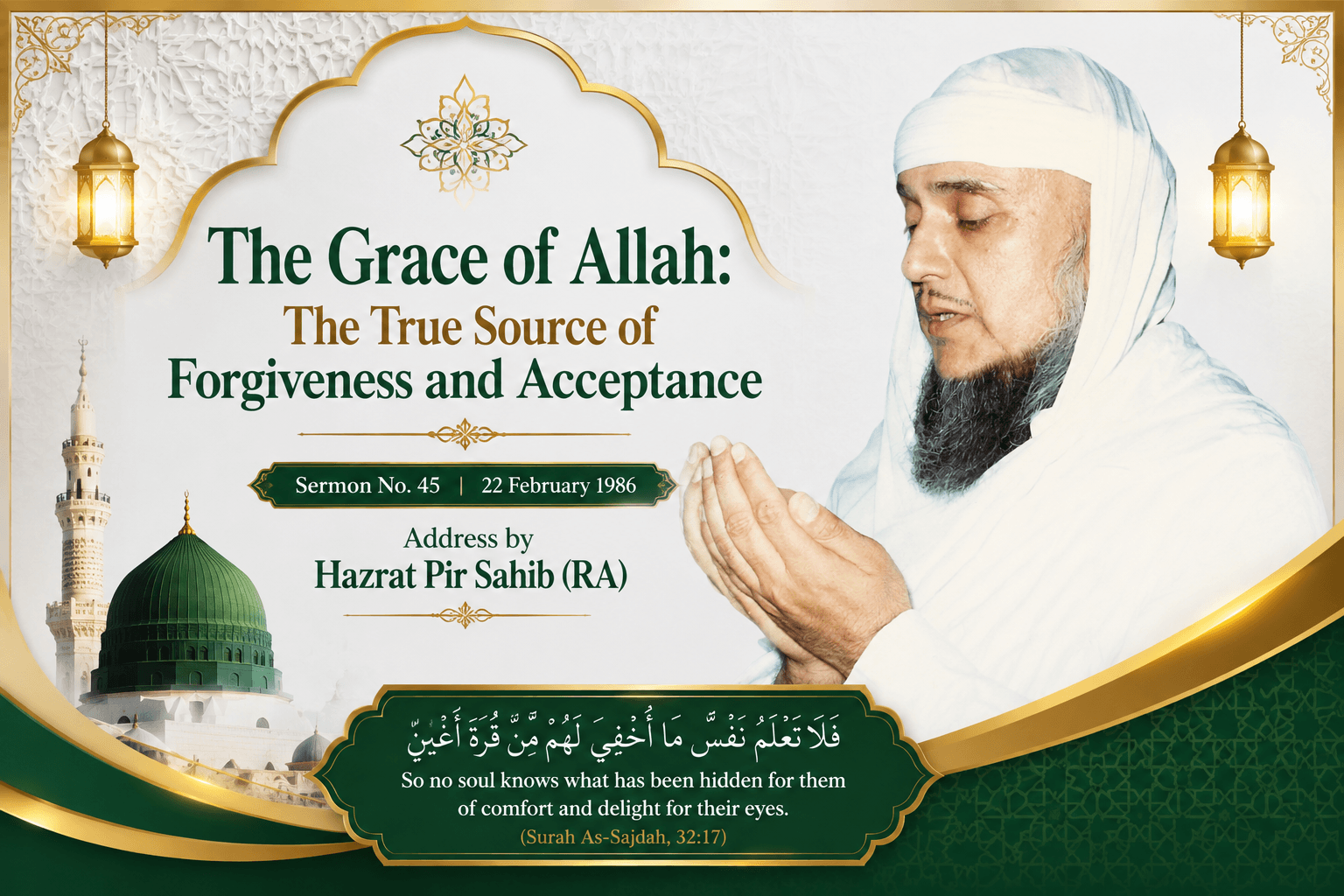
Address by Hazrat Pir Sahib (RA)
22 February 1986
Sermon No. 45
بِسْمِ اللّٰهِ الرَّحْمٰنِ الرَّحِیْمِ
فَنِعۡمَ الۡمَوۡلٰی وَ نِعۡمَ النَّصِیۡرُ
رَبِِّ اشۡرَحۡ لِیۡ صَدۡرِیۡ وَیَسِّرۡ لِیۡۤ اَمۡرِیۡ وَ احۡلُلۡ عُقۡدَۃً مِّنۡ لِّسَانِیۡ یَفۡقَہُوۡاقَوۡلِیۡ
اَللّٰهُمَّ صَلِ عَلٰی سَیّدِنَا مُحَمَّدٍوَّعَلٰی اٰلِ سَیِّدِنَا مُحَمَّدٍوَّعَلٰی اَصْحَابِہٖ وَعَلٰی اَذْوَاجِہٖ اَجْمَعِیْنَ وَبَارِکْ وَسَلِمْ وَصَلِ عَلَیْہٖ
All Praise Is for Allah
Countless thanks to Allah Almighty, the Master of all dominion, who has once again granted us the opportunity and privilege to gather here for His pleasure, in His remembrance and in His love. Millions and billions of blessings and salutations upon the Leader of the Prophets, the Beloved of Allah, Hazrat Muhammad Mustafa (PBUH), through whose blessed grace this kindness has been bestowed upon us.
Dear listeners! It is mentioned in a sacred Hadith that on the Day of Judgment there will be three registers: one containing a person’s good deeds, another containing his sins, and a third containing the blessings of Allah upon him.
Allah will command that all of a person’s good deeds be weighed against the blessings He has bestowed upon him. All his good deeds will be weighed, yet they will not equal even one small blessing of Allah.
Then the person will become distressed and say before Allah, “O Allah! It is only through Your mercy that I can be saved from Hell, and not because of my deeds.” Thus, he will be forgiven.
Allah has declared that no person’s good deeds alone can take him into Paradise. It is only the Grace of Allah that can grant him entry.
When the Messenger of Allah (PBUH) announced this, the Companions asked, “O Messenger of Allah (PBUH), will even you receive Allah’s Grace?”
He replied, “Yes, even I cannot be saved except through His Grace.”
God forbid, no one should misunderstand this statement to mean that the Messenger of Allah (PBUH) had sins or shortcomings that would prevent him from being saved. To think in such a manner is disbelief.
Rather, the meaning is that the exalted rank granted to the Messenger of Allah (PBUH), his protection from sins, his purity, and the fact that he was made the reason for the creation of the entire universe—all of this is itself a manifestation of the Grace of Allah upon him.
The Acceptance of Our Deeds Depends Upon Allah’s Grace
Coming to the main point: if someone thinks that his fasting, prayers, and good deeds are sufficient for his forgiveness, then this is a mistaken belief.
Only the Grace of Allah can become the cause of the acceptance of our fasts, prayers, charity, and other good deeds. Otherwise, the ego can create such circumstances that these very good deeds and acts of worship may be rejected and thrown back at a person.
These blessed litanies and spiritual recitations are performed so that Allah may bestow His Grace upon us, and through them we may seek forgiveness in the Divine Court.
There is no greater means and spiritual avenue than this. Therefore, one should not abandon this precious means with one’s own hands and then fall into heedlessness.
If a person sits comfortably at home, leaning against his cushions, performs his prayers and worship, and begins to think in his heart that he is doing Allah a great favour, then this is a great misfortune.
Look at prayer: prayer itself is an act of worship, but standing, sitting, bowing and prostrating in order to complete the prayer are all acts of worship as well.
Therefore, whatever is done for the pleasure of Allah becomes worship.
A person who leaves his necessary activities, leaves his home, bears difficulties, and comes to participate in this gathering—the sitting itself is an act of worship through the remembrance of Allah, and all the additional hardship he bears is also worship.
In this way, such a person can attain a much greater reward in the sight of Allah than someone who does not sacrifice his time or endure hardship beyond what is necessary for his home, children, parents, and worldly responsibilities.
The Importance of the Remembrance of Allah
The importance of the remembrance of Allah is manifested in the hearts of both such people, and the greater its importance in the heart, the greater will be its acceptance.
While reciting these blessed litanies, we should keep this thought in our hearts: may Allah Almighty preserve within our hearts this love and eagerness for His remembrance.
May He keep us in this state throughout our lives, and may the world remain insignificant in our eyes.
May Allah grant us all those rewards and blessings that He has prepared for His servants.
Because of our limited understanding, we consider the world and its pleasures to be everything. Yet a Hadith tells us that if the entire world had the value, in the sight of Allah, of even the wing of a mosquito, He would not have given even that to the disbelievers.
Allah Almighty has prepared for those servants who are always, everywhere, and in every circumstance ready to sacrifice everything for Allah, such blessings and delights that no one can see or even imagine in this world. These blessings have been kept hidden.
Allah says:
فَلَا تَعْلَمُ نَفْسٌ مَّآ أُخْفِيَ لَهُمْ مِّنْ قُرَّةِ أَعْيُنٍ ۚ
(Surah As-Sajdah, 32:17)
Translation:
“So no soul knows what has been hidden for them of comfort and delight for their eyes.”
No one knows what Allah Almighty has kept hidden for them as a source of comfort and joy.
There is not as much delight in receiving something whose nature is already known as there is in receiving something whose reality is completely unknown and unexpected.
Now begin reciting with full concentration, attention, certainty, and humility.
بِسْمِ اللّٰهِ الرَّحْمٰنِ الرَّحِیْمِ
The blessed Awraad-e-Naziriyyah Sharif were recited, followed by supplication.